

What if the most thoughtful tip at a Fiji luxury resort is the one you don’t hand to an individual? With the lagoon beyond your bure and attentive service close at hand, it’s natural to wonder what’s expected. Tipping etiquette in fiji luxury resorts often starts with the property’s own policy, not an Australian habit or a fixed amount.
A service charge can look like a tip, but its meaning isn’t always clear. Some resorts discourage individual gratuities and invite guests to contribute to a shared staff fund; others leave tipping to your discretion. A sincere “vinaka” is welcome, too.
This guide explains how resort policies shape tipping, what to look for in information about service charges and staff funds, and how to decide what feels right during your stay. A little preparation can help you show appreciation simply and respectfully, without feeling obliged to tip or worrying that you’ve misread the custom.
Key Takeaways
- Tipping etiquette in fiji luxury resorts depends on each property, so don’t assume luxury means a standard gratuity is expected.
- Check what a “service charge” means on your bill; it may not be the same as a shared staff gratuity.
- Follow the resort’s stated system, whether it invites contributions to a staff fund or leaves individual tips to your discretion.
- For especially thoughtful service or a memorable experience, a discreet tip is one way to say thank you. A sincere verbal expression of appreciation matters, too.
- Before you travel, review resort information and inclusions so tipping is one considered detail in a holiday shaped around your preferences.
Tipping etiquette in Fiji luxury resorts: what should guests expect?
Tipping customs vary from one Fiji resort to another, so don’t assume a gratuity is expected, included or handled the same way everywhere. A polished setting and attentive service don’t create a universal tipping rule. Each property has its own arrangements, described in its guest information and shaped by how its services are organised.
Resort tipping etiquette is context-sensitive guest appreciation: a voluntary thank-you guided by the property’s stated policy and the service you’ve received. A tip can be a personal gesture of appreciation, but it isn’t automatically an obligation. Following the resort’s stated arrangement is considerate, whether that means using a shared fund or choosing not to give an individual gratuity.
Why there is no single tipping rule for every Fiji resort
Resorts can differ in how they handle gratuities. One may explain a shared staff fund in its guest information; another may leave individual tips to guests’ discretion. Even properties with similar settings can have different systems, so a custom you encounter at one resort shouldn’t be treated as a rule for every island, team or stay.
Tipping customs also differ across countries and communities. For a broad overview, see Tipping customs around the world. Use that wider context as a starting point, not as evidence of a single Fiji-wide practice. For your stay, the resort’s own guidance is the most relevant reference.
A respectful starting point for Australian visitors
Australian habits may feel familiar, but they don’t determine what’s expected at a resort in Fiji. Arrive with an open mind rather than a fixed amount or routine. Read the guest information and look for details on gratuities or staff funds. Then follow the system the property describes.
If the written information is unclear, don’t assume a particular charge is a tip or that an additional gratuity is expected. You can choose not to tip, or simply express your appreciation with a warm “vinaka.” There’s no need to compare what different guests give.
Understanding the resort’s guest information helps you settle in with greater confidence and focus on the setting, the people and the experiences that connect you with the place. Those elements are part of the authentic Fiji resort experience. The next sections explain how service charges, shared gratuities and voluntary tips may be handled, so you can respond to the arrangement in front of you rather than rely on guesswork.
Service charges and shared gratuities: how Fiji resort arrangements may work
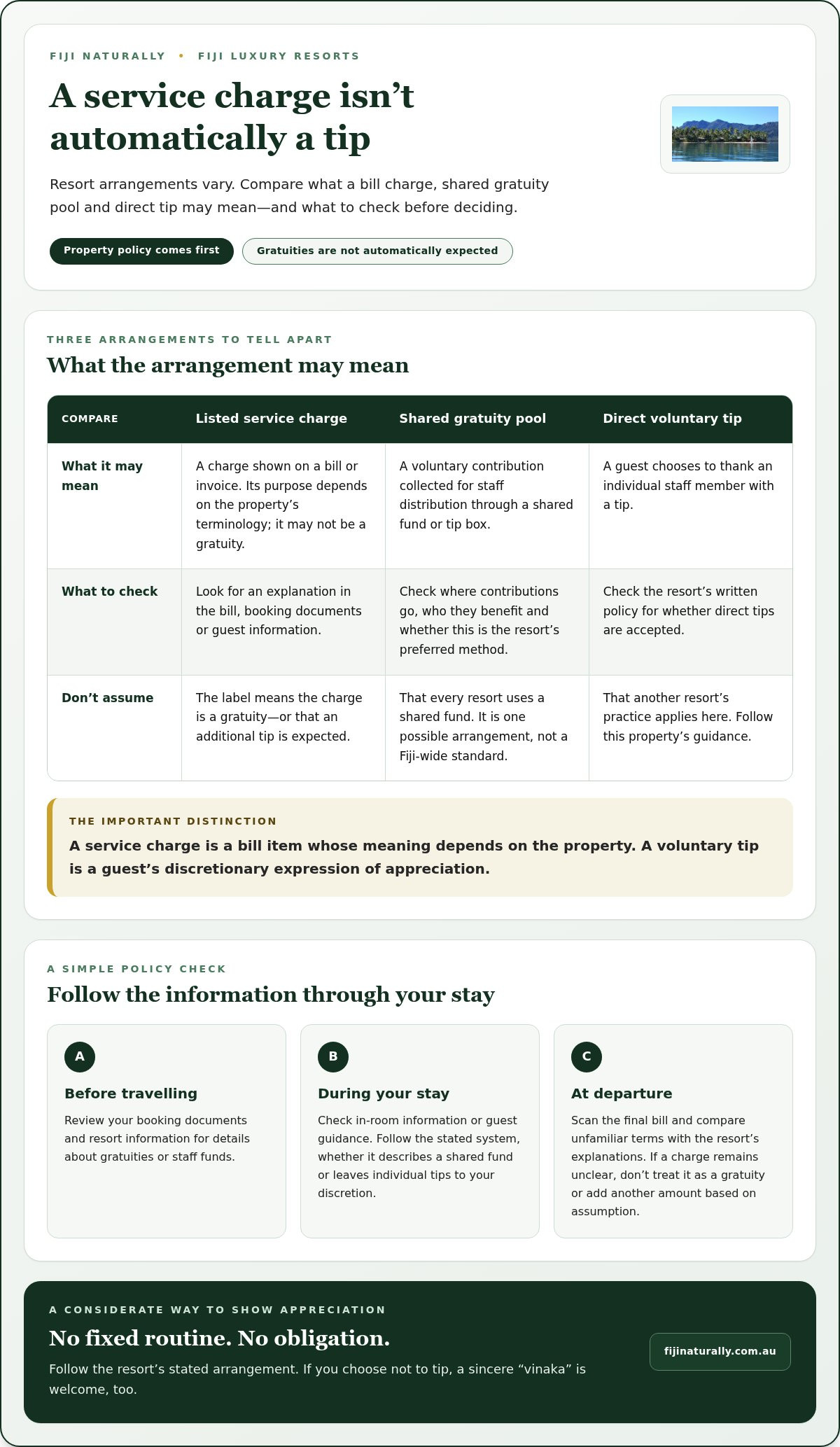
A line on a bill, a contribution box at reception and a tip handed directly to a staff member can all represent different arrangements. The terms aren’t interchangeable, and no single system applies to every Fiji luxury resort. Use the table as a guide to possible arrangements, then refer to the property’s guest information to understand what applies during your stay.
| Arrangement | What it may mean | What to check |
|---|---|---|
| Listed service charge | A charge shown on a bill or invoice. Its purpose can depend on the property’s terminology; it may not be a gratuity. | Look for an explanation in the bill, booking documents or guest information. |
| Shared gratuity pool | A voluntary contribution collected for staff distribution through a shared fund or tip box. | Look for details about where contributions go, who they benefit and whether this is the resort’s preferred method. |
| Direct voluntary tip | A guest chooses to thank an individual staff member with a tip. | Check the resort’s written policy for whether direct tips are accepted. |
A service charge and a voluntary tip aren’t automatically the same: one is a bill item whose meaning depends on the property, while the other is a guest’s discretionary expression of appreciation. “Service charge” can be used differently across hospitality settings. Don’t assume a charge is a gratuity or that it means an additional tip is expected.
How to read a resort bill and guest information
Start with the wording. A clearly itemised line on a bill is different from a note inviting an optional gratuity, but the label alone may not explain how a charge is used. Review your booking documents before travelling, then check in-room information or guest guidance once you arrive. At departure, scan the final bill and compare unfamiliar terms with the explanations in the resort’s information. If the purpose of a charge remains unclear, don’t treat it as a gratuity or add another amount based on assumption.
Shared tip boxes and direct appreciation
A shared pool is one possible way for a resort to collect gratuities, but it isn’t a Fiji-wide standard. A shared arrangement may distribute contributions among staff rather than give them to one person. At other properties, a guest may be able to offer a direct tip, provided that this fits the resort’s guidance. For a named resort, rely on its current information about how gratuities are handled rather than assuming another property follows the same practice.
For an Australian traveller, the simplest method is to follow the stated system rather than apply a familiar habit automatically. Read the information, understand the wording and then decide whether and how you’d like to show appreciation. Knowing what’s included in a stay can also make planning feel more considered. Thoughtful Fiji holiday planning brings practical details into focus alongside the resort experience you’re looking for.
Choosing when and whom to tip during a luxury Fiji stay
A useful way to decide is to focus on the moment, not a tipping formula. Did someone make a practical request easier, offer especially attentive help or shape an experience you’ll remember? A tip may be one way to acknowledge that care, but it isn’t the only one. Your comfort and the resort’s guidance both matter, and excellent service doesn’t automatically create an obligation to pay extra.
For tipping etiquette in fiji luxury resorts, separate three questions: what happened, who provided the service and what system applies. That keeps your response thoughtful rather than automatic.
Everyday service and exceptional personal attention
Routine service and a standout personal gesture can feel different to a guest, but neither has a universal tipping rule. Consider the experience rather than judging staff against one another. For example:
- Attentive everyday care: A warm greeting, a well-kept room or consistently helpful service may prompt a sincere “vinaka” or another thank-you, even if you choose not to tip.
- A special request: If a team member takes extra care to help with a request, you might wish to show appreciation. First follow any resort guidance on whether tips should go directly to staff or through a shared arrangement.
- A memorable experience: A thoughtful touch that makes a meal, activity or special occasion particularly meaningful may inspire a voluntary gratuity, a kind word to the team or feedback to the resort.
These are examples, not expectations. If the resort explains that gratuities should be shared, respect that preference rather than handing money to one person. If it permits direct tips, you can decide whether a particular interaction merits one. A genuine expression of thanks is appropriate either way.
Resort staff, guides, and services beyond the resort
Not everyone who contributes to your holiday is necessarily covered by the resort’s gratuity arrangements. A guide leading an excursion or a driver working for a separate transfer provider may have different instructions from resort employees. Don’t assume their service is included in your resort bill or that the resort’s staff-fund system applies to them.
Use any written information supplied for the specific activity or transfer to understand its gratuity arrangements. The resort’s policy doesn’t automatically apply to services organised separately. Where no guidance is provided, there’s no need to assume a tip is expected. Keep any expression of thanks discreet and simple, without comparing staff or service providers in public.
Ultimately, choose a response that feels sincere and respects the arrangement in place. A voluntary tip, a direct thank-you or a note of appreciation can each recognise good service. You don’t need to assign a fixed amount or percentage; let the available guidance and your own comfort guide the decision.
A simple, culturally considerate tipping plan for your Fiji holiday
A little preparation can make tipping feel like a quiet, uncomplicated detail rather than a decision you have to revisit after every interaction. Move from information to observation, then decide. That keeps tipping etiquette in fiji luxury resorts grounded in the specific property you’re visiting, not assumptions borrowed from another resort or from home.
- Review the resort information. Before arrival, look through your booking documents and guest guidance for references to gratuities, staff funds or service charges.
- Understand the bill. Check how any charge is described and whether the resort explains its purpose. Don’t assume an itemised charge is a gratuity or that it replaces one.
- Observe the stated system. During your stay, follow any clear preference for a shared pool or direct tips. If the written guidance is unclear, avoid guessing.
- Decide what feels right. If the policy allows it and you want to recognise a particular act of care, choose whether to offer a tip. A warm thank-you is also a complete expression of appreciation.
Before arrival: understand the property’s arrangements
Start with the information for your own resort. Policies can differ, so don’t use another property’s practice as a guide. Look for the wording used in booking documents and guest materials, and note any questions about the bill or how gratuities are handled. This gives you a clear basis for deciding what to do once you arrive.
During the stay: keep appreciation natural and discreet
Let the resort’s clearly communicated preference guide how you show appreciation. If it directs guests to a shared fund, use that arrangement; if direct tipping is permitted, you can decide privately whether to offer a tip. Avoid comparing what different staff members receive, and don’t assume a shared contribution is distributed in a particular way unless the resort explains it.
If you’re unsure, you don’t need to force a decision in the moment. A sincere “vinaka,” a personal thank-you or a note recognising helpful service can convey genuine warmth without money. The aim isn’t to rank staff or find a perfect formula; it’s to respond thoughtfully while respecting the property’s guidance.
Quick checklist: Read the resort’s guidance, understand the bill, follow the stated arrangement and choose a discreet thank-you that feels comfortable to you.
Clear guest information and a resort that suits your travel style can make the practical details easier to understand before you arrive. Plan a Fiji resort stay around your preferences with expert support for choosing a considered stay and planning the arrangements around it.
Plan a Fiji luxury resort stay with fewer unanswered details
A considered Fiji holiday begins with more than choosing a beautiful place to stay. The right resort should suit how you want to spend your days, whether that means slipping beneath the water, finding a quiet island retreat, sharing time together as a family or settling into a romantic escape. When the setting and style fit, practical details such as inclusions and tipping arrangements are easier to understand as part of the whole experience.
That’s where tipping etiquette in fiji luxury resorts belongs: as one small part of a larger plan, not the decision that defines your holiday. Resort policies vary, so reviewing property information before you arrive helps you approach gratuities calmly and focus on the reef, the shoreline and the moments you came to enjoy.
Match the resort experience to the way you want to travel
Start with the feeling you want from your stay. If diving is central, look for a resort that suits your underwater interests and experience level; a luxury Fiji dive resort guide can help you explore options. For a family holiday, consider how the resort’s setting and style fit the time you want to spend together, using a Fiji family resort guide as a starting point. For seclusion or a romantic break, the pace, privacy and character of the property may matter most.
These preferences shape more than the view from your room. They influence the activities you plan, the services you use and the guest information that will be useful. Fiji Naturally’s team has personally visited more than 100 locations, bringing first-hand insight to choosing a stay that aligns with your priorities. That expertise can help you compare boutique resorts, private islands and dive-focused escapes without treating every luxury property as the same experience.
Make the practical details feel as considered as the setting
A well-planned itinerary brings the pieces together: the resort, flights, transfers and travel insurance. Looking at them as one holiday plan can help you understand what your stay includes, which arrangements sit outside the resort and where to find relevant guest information. It also gives you a clearer picture of the practical details to review, including the property’s guidance on gratuities, before your days fill with swimming, exploring and long, unhurried meals.
As a Virtuoso travel agency specialising in personally vetted luxury Fiji stays, Fiji Naturally shapes travel plans around each traveller’s preferences. The aim is not to prescribe a tipping choice, but to make the wider holiday feel thoughtfully connected, from the resort that suits you to the arrangements around it.
If you’re beginning to imagine your own island stay, explore Fiji Naturally’s luxury travel planning as a calm next step towards a Fiji holiday shaped around the experiences you value.
Let your Fiji escape take shape
With your approach to tipping clear, you can turn your attention to the experience you want to carry home: a quiet morning beside the lagoon, time underwater or days shared with family. The right resort and travel arrangements can make those moments feel effortless, while leaving room for the unexpected pleasures of island life.
Fiji Naturally is a Virtuoso travel agency specialising in curated Fiji resorts, private islands and dive stays. Its experts have personally visited more than 100 locations, bringing first-hand insight to planning a holiday around your preferences. That perspective can help you explore boutique resorts, private islands and dive-focused stays, while making it easier to review practical details such as resort guest information before you travel.
When you’re ready to imagine your own Fiji holiday, explore a thoughtfully planned Fiji luxury holiday. Fiji Naturally can help you bring together resort bookings, flights and travel insurance around the experiences you value.
Frequently Asked Questions
Can I tip Fiji resort staff in Australian dollars?
You can offer Australian dollars only if the resort or staff member is comfortable accepting them, so don’t assume they’re suitable. Fijian dollars are the more practical choice for a gratuity in Fiji, particularly if you’re giving cash directly. If you’d rather not exchange money just for tipping, check the resort’s written information for accepted methods. A thank-you doesn’t need to involve cash.
Is cash or card better for tipping at a Fiji luxury resort?
Cash may be simplest for a direct gratuity, but the best method depends on the resort’s arrangements. A card payment may not allow you to designate an amount specifically for staff, and adding money to a bill doesn’t automatically mean it will be treated as a tip. Check the resort’s written information about card gratuities and how they’re recorded, especially if your account includes other charges.
Should I tip resort staff individually or use a shared tip box?
Follow the resort’s instructions rather than choosing a method based on what you’ve seen elsewhere. If its guidance directs guests to a shared tip box, use that instead of handing money to an individual. If direct tips are permitted, you can decide whether to thank a particular staff member that way. The right choice depends on the property’s policy, not a universal rule.
Do I need to tip if I am travelling with children?
No, travelling with children doesn’t create a separate tipping requirement. Your family can follow the same resort guidance as other guests and decide what feels appropriate within that arrangement. If a staff member has gone out of their way to help your family, a warm thank-you is always an option; a tip is voluntary, not a condition of receiving attentive service. Don’t feel pressured to tip on behalf of each child.
What should I do if I do not have cash during my resort stay?
You don’t need to find cash simply because you’re unsure how to thank someone. Use the resort’s written information to see whether card gratuities or another contribution method are accepted and how contributions are handled. Don’t add an amount to your room account without understanding its purpose. If there’s no suitable method, express your thanks directly or share positive feedback with the resort.
Should I tip resort staff before I leave Fiji?
You don’t need to wait until you leave Fiji. If you choose to give a gratuity, follow the resort’s guidance, which may specify a particular place or moment during checkout. For a shared fund, check whether the property recommends contributing before departure so there’s time to follow its process. Don’t leave cash somewhere without knowing who will receive it.
Can I ask the resort how its tipping system works?
Yes, asking is a sensible way to avoid guessing. Start with the resort’s guest information, booking documents and any explanation on your bill. Look for whether a listed service charge is a gratuity, whether contributions are shared and which methods are accepted. If the written guidance doesn’t explain the arrangement, don’t assume a tip is required or that a charge goes to staff. This is a practical part of tipping etiquette in fiji luxury resorts.


