

What if the cheapest-looking Fiji booking isn’t the one that gives you the best value? If you’re wondering “what do fiji travel agents charge,” the answer depends on how your trip is planned and booked. An agent may earn commission from suppliers, charge you a service or planning fee, or use both. The arrangement can differ by agency and booking, so compare what you pay with the work and support included.
It’s reasonable to ask what a fee covers and how recommendations are made. A straightforward resort stay may need little coordination. A remote-island escape involving flights, transfers and diving can require more planning to bring the pieces together.
This guide explains common ways agents earn from Fiji bookings, which services may involve a direct fee, and how to weigh the cost against the support behind your itinerary. You’ll also see how specialist knowledge can help connect resort stays, flights, insurance and activities. Fiji Naturally’s team has personally visited more than 100 locations, bringing first-hand context to choosing a stay that fits the experience you want.
Key Takeaways
- There’s no single answer to “what do fiji travel agents charge”: costs depend on the agency, booking and planning involved.
- A service fee pays for work, while commission is paid to an agency by a travel supplier.
- Compare self-booking and agent assistance by the time, coordination, specialist knowledge and support involved, not by assuming one option will cost less.
- Review booking components, cancellation terms and who coordinates the itinerary to make a like-for-like comparison.
- For a complex, remote or dive-focused holiday, specialist Fiji knowledge can help bring resort stays, flights and travel insurance together around your priorities.
What do Fiji travel agents charge, and why is there no single answer?
There’s no standard charge for booking a Fiji holiday through a travel agent. The amount, if any, depends on the agency, the service and how the booking is arranged. One agent may charge you for planning or ticketing; another may earn commission from a supplier; some may use both. The arrangement can differ between flights, a resort stay and other parts of the same trip.
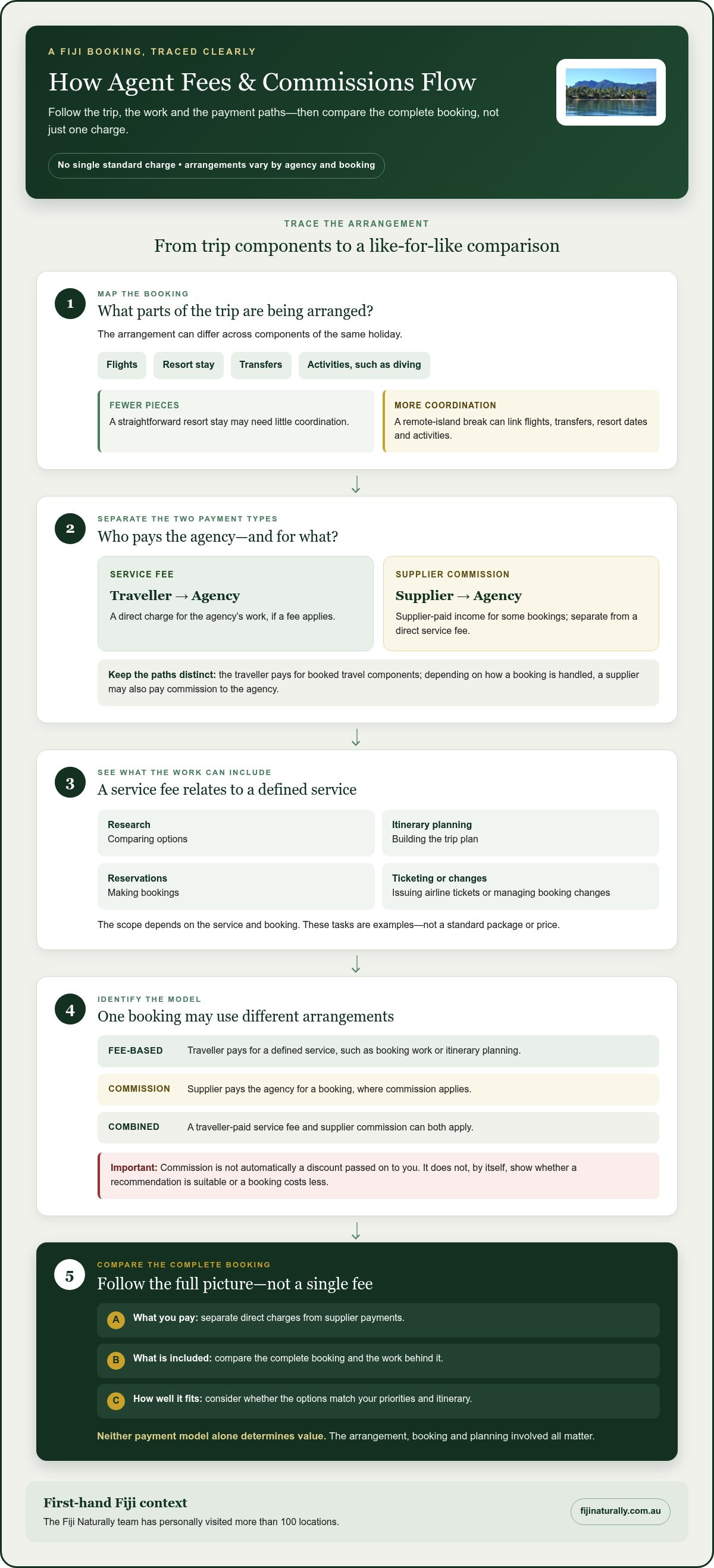
A service fee is charged to the traveller for work; a commission is paid to the agent by a travel supplier for a booking. Keeping those payment paths separate shows what you pay directly and how an agency may earn revenue. Neither model, by itself, tells you whether a trip is good value.
What counts as a travel agent fee?
A service fee may cover work such as researching options, building an itinerary, making reservations, issuing airline tickets or managing booking changes. The scope depends on the service and booking. A fee charged to you is different from supplier revenue: it’s a direct charge for the agent’s work, rather than a payment from a resort, airline or another travel business. Agencies can structure these arrangements differently.
For example, someone arranging a resort stay and flights might pay a ticketing fee, a separate planning charge, or a broader service fee. That’s an illustration, not a standard package or price. The work involved in coordinating one resort stay may differ from planning a remote-island break with several connections and activities.
Do Fiji travel agents get discounts or commissions?
Travel suppliers may pay agents commission for some bookings. This is supplier-paid revenue, not automatically a discount passed on to you, and it’s separate from any direct service fee. Industry rates or conditions intended for travel professionals also shouldn’t be mistaken for prices available to ordinary travellers.
Commission alone doesn’t prove a recommendation is unsuitable, nor does it mean a booking will cost less. It’s one possible part of how an agency earns income. Compare the complete booking: what’s included, what you pay, and how well the recommended options match your priorities. Fiji’s tourism sector sits within a wider supplier network; the Economy of Fiji overview provides broader context, but it doesn’t determine how a particular agency is remunerated.
So, what do fiji travel agents charge? The clearest answer comes from looking at the booking, not assuming a single rate. Fiji Naturally earns through commissions and service fees. The payment arrangement can vary with the booking and work involved. Separate any direct charges from supplier payments, then consider what the agency is doing: comparing resort options, aligning flights with island connections, or coordinating a dive-focused stay. Those details make the total easier to assess without assuming every agency or itinerary follows the same model.
How Fiji travel agent fees and commissions can work
A Fiji holiday can involve several separate bookings, each with its own payment path. You pay for the trip; the agency may receive a direct service fee from you, commission from a supplier, or both. Depending on the booking, an airline, resort or other travel supplier receives payment for its part of the arrangements and may also pay commission to the agency. These are possible models, not one formula for every itinerary.
A commission is supplier-paid income for a booking; a service fee is a separate charge to the traveller for the agency’s work. An agency may charge a service fee even when supplier commission also applies. If both appear in an arrangement, they are separate charges. Look at who pays each amount and what it relates to.
Service fees, supplier commissions, and combined models
In a fee-based arrangement, you pay for a defined service, such as booking work or itinerary planning. In a commission-based arrangement, a supplier pays the agency for a booking. A combined model can include both: a traveller-paid fee for planning alongside commission from a supplier. The arrangement may vary by agency and booking, so don’t assume every part of a Fiji trip follows the same model.
A simple payment map can help:
- Traveller to agency: a service fee, if one applies to the work.
- Traveller to supplier: payment for booked travel components, depending on how the booking is handled.
- Supplier to agency: commission, where applicable to that booking.
Fiji Airways industry rates are a separate matter. Eligibility or conditions for an industry rate don’t establish the price an ordinary traveller will pay, whether an agency charges a service fee, or whether an agent receives commission on a particular ticket. An industry rate shouldn’t be treated as proof of a consumer discount. The Fiji Hotel and Tourism Association offers context on the wider hotel and tourism sector, but an industry body’s information doesn’t determine an individual agency’s payment arrangement.
Why flights, resorts, and tailored planning may be treated differently
Each trip component involves different work. Airline ticketing may involve selecting flights and issuing tickets; a resort reservation centres on the stay and its booking terms; tailored itinerary planning can mean fitting several choices together. A remote-island holiday or multi-stop route may need more coordination across flights, transfers, resort dates and activities than a single-stay itinerary. The work can affect an agency’s fee arrangement, but it doesn’t establish a specific charge.
For travellers asking what do fiji travel agents charge, the useful comparison is the payment flow behind each component, not an assumed industry rate. Fiji Naturally brings specialist knowledge to resort, airline-ticket and travel-insurance bookings, with planning shaped around the trip. Learn more about Fiji holiday planning with Fiji Naturally.
Is using a Fiji travel agent worth the charge? Compare the value
An agent’s value isn’t measured by an assumed discount. Consider how much time, coordination and destination knowledge your trip calls for, and how much responsibility you want to handle yourself. A simple resort stay may be easy to arrange independently. A dive holiday involving flights, island transfers and several stops can take more research to shape into a workable itinerary.
Use this comparison to decide which details you’d prefer to manage and where coordination could help:
| Planning task | Booking independently | With agent assistance |
|---|---|---|
| Research and shortlist | Compare resorts, locations, travel dates and activities yourself. | An agent may help narrow options around your priorities, such as diving, family facilities or seclusion. |
| Flights and connections | Choose flights and keep track of how schedules fit your stay. | An agent may coordinate airline bookings with resort dates and the wider itinerary. |
| Island transfers and multiple stops | Check how each leg connects and manage arrangements across providers. | An agent may help organise the moving parts into a more coherent route. |
| Changes and trip details | Keep your own records and follow up with the relevant suppliers. | An agent may provide booking support according to the service arranged. |
When specialist planning can add practical value
Specialist support can be useful when one choice affects several others. For a dive-focused stay, the resort’s location and access to sites matter alongside flight timing and transfers. A private-island retreat or a multi-resort holiday can also take more coordination than a single booking. Fiji Naturally’s experts have personally visited more than 100 locations, bringing first-hand context to choices shaped by diving, family needs or a quieter escape. For underwater-focused options, the Luxury Fiji dive resorts guide explores considerations for matching a stay with your diving priorities.
That experience doesn’t guarantee a particular outcome or make every agent-assisted trip cheaper. Its value is the context it brings when assessing how a resort, flights, insurance and activities fit together, especially when the itinerary has several connected parts.
When a traveller may prefer to book independently
If you’re confident comparing options and your plans are simple, arranging a resort stay and flights yourself may feel clear and manageable. You keep control of the research and bookings, while also taking responsibility for checking schedules, organising details and following up with separate suppliers. There’s no single right approach.
Consider how many components need to align, how much time you want to spend researching, and how much support you value during planning. That’s a more useful way to assess what do fiji travel agents charge than assuming a fee will save money. For a straightforward trip, independent booking may suit you. For a remote, dive-focused or multi-stop itinerary, weigh specialist coordination against the work you’d otherwise manage yourself.
How to understand the charges before planning your Fiji holiday
Before comparing Fiji holiday options, separate the planning service from the bookings themselves. Flights, resort stays, travel insurance and transfers may each have different inclusions, terms and payment arrangements. Reviewing each component helps show what a quoted total covers, where coordination fits in, and whether two options are genuinely comparable.
A simple checklist for comparing agent charges
Use these steps to understand the service and assess its value:
- Identify the work covered. Does the service focus on making bookings, or include itinerary planning and coordination across trip components?
- Separate payment types. Distinguish any fee you pay for the agency’s work from supplier-paid commission, where disclosed. They are different payment flows.
- Compare the whole itinerary. Consider what’s included, the booking terms and who coordinates the arrangements, rather than comparing a fee label alone.
Then map the components of your holiday. Review the flights and their conditions, the resort stay and its inclusions, the travel insurance arrangements, and how transfers fit the route. A resort booking alone isn’t directly comparable with an itinerary that also accounts for travel between islands. A clear breakdown helps show whether differences reflect the trip itself or the service around it.
What to weigh beyond the headline fee
A fee is one part of the decision, not the full measure of value. Consider the time you’d spend researching, the destination knowledge brought to the planning, the coordination involved, and the support included in the service. These factors matter differently for different trips. A single resort stay may be straightforward to organise; a remote-island itinerary can involve more connected details.
Check cancellation and change conditions for the actual bookings, not just a general summary of the agent’s service. Flights, accommodation and transfers may each have their own terms. Note who handles coordination if dates shift or arrangements need attention, then compare options with equivalent inclusions and conditions.
For example, a private-island dive holiday may require aligning the resort choice with your diving priorities, flights and onward transfers. The Fiji private-island dive resorts guide can help you think through that kind of itinerary. A lower upfront fee doesn’t necessarily mean a lower overall trip cost, just as a higher fee doesn’t automatically mean more value. Assess the complete arrangements and the work they save you.
For more on how resort, flight and insurance arrangements can fit your priorities, explore Fiji holiday planning with Fiji Naturally.
How Fiji Naturally brings specialist planning to a Fiji trip
Fiji Naturally is an Australian, Virtuoso-affiliated specialist agency focused on curated, high-end Fiji holidays. Its full-service travel planning brings key trip components together, including resort bookings, airline tickets and travel insurance. The itinerary can be shaped around what matters to you, whether that’s time underwater, a secluded island stay or a holiday balancing relaxation with exploration.
Fiji Naturally earns through commissions and service fees, with arrangements depending on the booking and work involved. That context matters when weighing what do fiji travel agents charge. Specialist planning isn’t a promise of a lower price. It provides the opportunity to make considered choices with a clearer view of how each part fits into your trip.
What specialist Fiji planning can bring together
A resort can shape more than where you sleep. Its location and character may influence flight plans, transfers and activities during your stay. Fiji Naturally’s experts have personally visited more than 100 locations, bringing first-hand perspective to choices among boutique resorts, private-island stays, family holidays and scuba-diving escapes.
For divers, planning can take account of how a resort aligns with the experience you’re seeking, including destinations such as Rainbow Reef, the Great White Wall or Namena Marine Reserve. Flights, accommodation and travel insurance are distinct components, but considering them as parts of one itinerary can help keep the overall plan coherent. For a sense of the qualities that can define a more locally grounded stay, explore the authentic Fiji resort experience guide.
That curation is especially relevant when you have specific priorities. A couple seeking quiet and seclusion may weigh different resort features from a family planning a relaxed island holiday. A diver may want to consider how a destination and stay fit the time they hope to spend on the water. First-hand knowledge adds context to those decisions without making the choice for you.
Take the next step towards a more considered Fiji itinerary
Start with the experience you hope to have. Think about your preferred pace, who’s travelling, what matters most in a resort, and whether diving, privacy or family-friendly surroundings are central to the trip. Those details give a specialist a useful starting point for shaping an itinerary.
If a thoughtful, coordinated approach feels right, explore Fiji holiday planning with Fiji Naturally. Share the kind of escape you’re imagining and your priorities, then consider how resort bookings, flights and travel insurance can fit together.
Shape a Fiji holiday around what matters to you
Picture the experience you want before weighing how to plan it. A few quiet days on an island, time beneath the water, or a journey linking several stays will each call for different choices. Knowing your priorities helps you judge what do fiji travel agents charge in the context of the work and coordination your holiday needs.
Think about how involved you want to be in comparing resorts, arranging flights and bringing separate pieces together. You might prefer to handle a straightforward booking yourself, or have a specialist help shape a considered itinerary. Either way, choose a plan that reflects your pace, interests and preferred level of support rather than deciding by a fee label alone.
Fiji Naturally is a Virtuoso-affiliated specialist agency, with experts who have personally visited more than 100 locations. Its full-service bookings include resorts, airline tickets and travel insurance. Explore a thoughtfully planned Fiji holiday with Fiji Naturally and start shaping an island escape around your priorities.
Frequently Asked Questions
Do travel agents charge a fee for booking Fiji holidays?
Sometimes, but the arrangement depends on the agency and the work involved. You might pay a direct charge for planning or ticketing, while another booking may be supported through supplier revenue, or a mix of both. Shaping a multi-stop itinerary involves different work from booking one resort. Compare the service and booking details rather than assuming every Fiji holiday has the same fee structure.
Do travel agents make commission on Fiji resort bookings?
Some travel agents may receive commission from a resort or another supplier for a completed booking. This is separate from any amount you pay directly for planning or booking assistance, and it doesn’t automatically mean the resort stay costs less. Compare the total price and what the reservation includes, such as the room arrangement, meals or activities, rather than treating commission as a discount.
Can booking through a travel agent make a Fiji holiday cheaper?
Don’t assume it will. An agent may help compare suitable options and coordinate details, but that doesn’t guarantee a lower total than booking independently. Compare the same travel dates, resort arrangement, flight conditions, inclusions and cancellation terms. Two quotes may differ because one includes another trip component or has different booking conditions. Judge the overall fit and value, not simply whether an agent is involved.
Are Fiji Airways industry rates available to ordinary travellers?
Industry rates are distinct from fares offered to ordinary travellers. They may have eligibility rules or conditions, so a reference to an industry rate doesn’t establish that a holidaymaker can book at that price. Nor does it reveal whether an agent charges a separate service fee for ticketing. For a fair comparison, look at fares available for your travel dates and circumstances, then consider the conditions alongside the rest of your itinerary.
Is it worth using a travel agent for a Fiji island-hopping trip?
It may be useful if your route links several islands, resorts or flight segments and you’d rather not coordinate every connection yourself. Check how arrival times, onward transfers and resort check-in dates fit together before settling on a sequence of stays. An agent can bring those moving parts into view, while independent planning may suit travellers who enjoy researching and managing each arrangement themselves.
What does a Fiji travel agent help organise besides accommodation?
Depending on the agency and service, assistance may extend to airline tickets, travel insurance and the wider itinerary. Fiji Naturally’s full-service bookings cover resorts, flights and travel insurance. For a dive-focused holiday, planning can also consider how your chosen stay relates to the experience you want, such as time around Rainbow Reef or Namena Marine Reserve. Review the service scope and booking terms so you know what’s included.
Can I book Fiji flights and resorts separately?
Yes. You can arrange flights and accommodation separately, then track how the dates and travel connections fit together. This gives you direct control over each booking, but also means you’ll need to review the terms and manage communication with each supplier yourself. Before committing, compare arrival and departure times with resort check-in dates and onward transport, especially if your plans include more than one island.
How can I compare travel agent fees with booking independently?
Compare equivalent itineraries, not just the headline fee. Include the same travel dates, flights, resort stay, insurance choices and other planned components, then review inclusions, cancellation terms and who coordinates changes. Also consider the time you’d spend researching and managing the bookings yourself. Asking “what do fiji travel agents charge” is a useful starting point, but the clearer comparison is what each arrangement covers and how it suits your trip.


