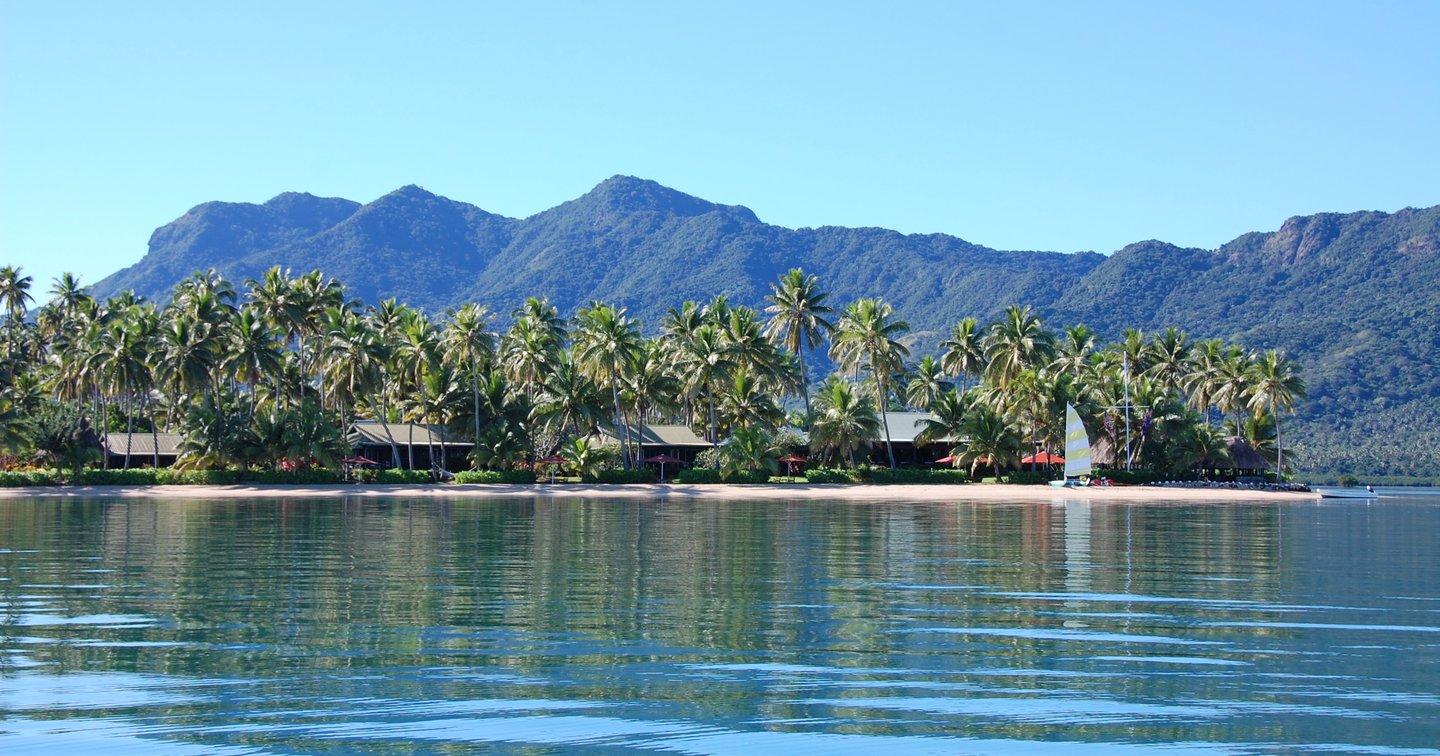

Most divers assume a tropical escape is simply a matter of dodging the rain. In the Somosomo Strait, the truth is far more nuanced; you could arrive in the middle of a sun-drenched week and still miss the very spectacle you flew across the Pacific to see. Finding the best time to dive rainbow reef fiji isn't just about the weather. It is about the pulse of the ocean. The pull of the moon. The rush of the tide.
You likely dream of the Great White Wall at its most luminous, with visibility stretching beyond 30 metres and soft corals expanded in a riot of neon. You don't want to risk the disappointment of cyclone season or the frustration of murky water and crowded mass-market boats. We understand that deep craving for authenticity and quiet. This guide identifies the precise windows in 2026 to witness this kaleidoscopic state, ensuring your journey aligns with the rare biological bloom that makes these waters legendary.
We will explore the peak visibility window from May to October, the specific 2026 lunar phases required for soft coral expansion, and how to select a boutique base like Viani Bay Resort or Taveuni Dive Resort to keep your experience intimate and soulful.
Key Takeaways
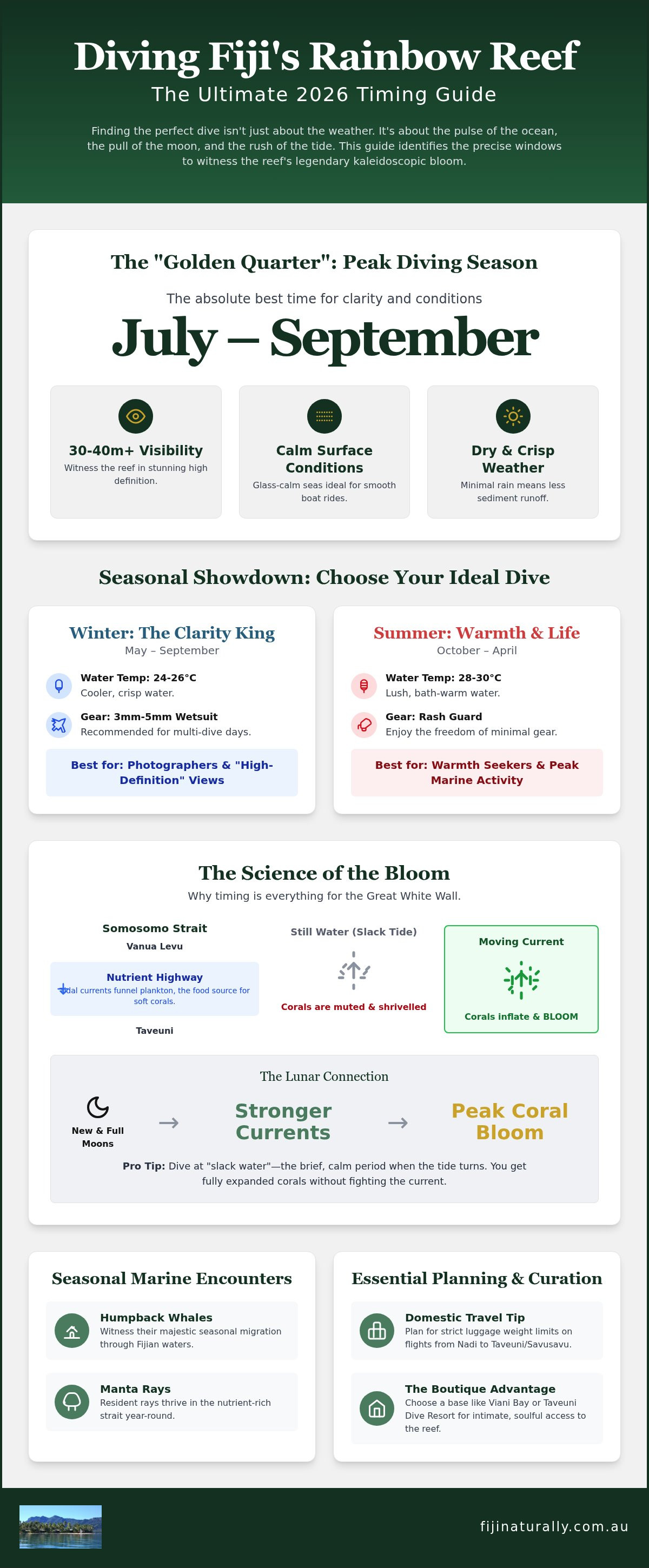
- Identify why the "Golden Quarter" from July to September is the best time to dive rainbow reef fiji, offering the most reliable 30-metre visibility and calm surface conditions.
- Understand the precise lunar and tidal rhythms required to witness the world-famous Great White Wall during its peak soft coral expansion.
- Align your 2026 journey with the seasonal migrations of Humpback whales and the resident Manta rays that thrive in the nutrient-rich Somosomo Strait.
- Navigate the essential logistics of island travel, including managing strict luggage weight limits on domestic transfers from Nadi to Taveuni or Savusavu.
- Discover the benefits of choosing a secluded, specialist base like Viani Bay Resort or Taveuni Dive Resort for intimate access to the reef's most pristine sites.
The Optimal Window: When to Experience the Rainbow Reef at its Peak
The Somosomo Strait does not follow a simple calendar. It breathes with the tides. While many claim you can dive here year-round, the truth is far more specific for those seeking perfection. The "Golden Quarter" spanning July to September represents the pinnacle of underwater clarity. During these months, the southeast trade winds settle. The air is crisp. The water is still. It is the definitive best time to dive rainbow reef fiji if your priority is witnessing the legendary Great White Wall in high definition.
However, true curation involves a choice between two distinct worlds. You must balance the crystalline 30-metre visibility of the cooler months against the velvety, bath-warm waters of the Fijian summer. If you prefer a quieter, more soulful experience, May and October are the true insider months. The seas are often glass-calm. The crowds are thin. At boutique sanctuaries like Viani Bay Resort or Taveuni Dive Resort, these shoulder months offer a sense of profound seclusion that mass-market resorts simply cannot replicate.
Winter Diving (May - September): The Clarity King
This is the season of the deep blue. From May through September, horizontal visibility often reaches a staggering 40 metres. The Rainbow Reef appears almost architectural in its sharpness. Because the weather is drier, there is minimal sediment runoff from the volcanic slopes of Taveuni. You will need a bit more protection; water temperatures dip to between 24°C and 26°C. We recommend a 3mm or even a 5mm wetsuit for those planning three dives a day. It is a small price to pay for seeing every translucent polyp of the soft corals in sharp, vivid relief.
Summer Diving (October - April): Warmth and Life
As the calendar turns toward November, the ocean warms significantly. Temperatures climb to a lush 28°C or 30°C. You can dive in a thin rash guard, feeling the soft embrace of the water during long, exploratory drifts. Visibility may soften slightly as plankton counts rise, but this brings a different kind of energy. The reef is busier. More activity. More life. Travelers should be mindful that this period coincides with the tropical cyclone season. Humidity is higher, and afternoon downpours are common. While the diving remains spectacular, the risk of weather-related cancellations increases, making comprehensive travel insurance a vital component of your 2026 planning.
Tides, Currents, and the Great White Wall: The Science of the Bloom
To understand the magic of the Somosomo Strait, one must first look at its geography. It is a narrow bottleneck between the islands of Taveuni and Vanua Levu. This channel acts as a biological funnel, forcing vast volumes of nutrient-rich water through a constricted space with every changing tide. This "nutrient highway" is the lifeblood of the region. It is the reason Fiji is crowned the soft coral capital of the world. Without these specific currents, the reef would be a quiet, skeletal place; with them, it becomes a pulsing, neon cathedral.
The star of this ecosystem is the Dendronephthya coral. Unlike many hard corals, these soft varieties are passive filter feeders that lack symbiotic algae. They rely entirely on the current to bring them food. When the water is still, the corals appear shrivelled and muted, resembling tiny, wilted heads of broccoli. But as the tide begins to push, they inflate with seawater, blooming into a kaleidoscopic forest of translucent branches. This is why the best time to dive rainbow reef fiji is dictated more by the clock and the moon than by the sun.
The Lunar Connection
The moon is the conductor of the Rainbow Reef's orchestra. During the new and full moons, the gravitational pull creates stronger, more energetic currents. While these "spring tides" bring the most nutrients and the most dramatic coral expansion, they can also make for challenging diving conditions. The secret lies in finding the "slack water" window. This is the brief, tranquil period when the tide is turning. The corals remain fully expanded and vibrant, yet the water is calm enough for divers to hover and capture that perfect, high-resolution photograph. If you want to time your descent to the exact minute of this biological peak, consulting a specialist who understands these local tidal charts is essential.
Witnessing the Great White Wall
The Great White Wall is the most famous expression of this tidal science. As you descend through a swim-through at roughly 15 metres, the world shifts from the sun-drenched lavender of the shallows to a deep, ethereal glow. The Great White Wall is a vertical drop-off covered in icy-white soft corals that only "bloom" in moving water. To see it at its best, you must be in the water during a specific outgoing tide. At this moment, the wall appears to radiate its own light, a sheer precipice of white that vanishes into the cobalt abyss. It is a sight that requires precision planning, but for those who get it right, it is the most profound underwater experience in the South Pacific.
A Seasonal Marine Calendar: What You’ll See and When
The Rainbow Reef is a shifting tapestry of life. It doesn't stay the same from week to week. While the soft corals are the permanent, kaleidoscopic residents of the Somosomo Strait, the seasons bring a rotating cast of ocean giants and tiny, hidden wonders. To plan your 2026 journey is to choose which chapter of this natural story you wish to witness. Whether you seek the shadow of a manta ray or the haunting song of a whale, timing is your most valuable tool.
Beyond the large-scale migrations, the reef flats teem with a staggering diversity of over 1,000 species of fish. In the shallower, sun-drenched gardens, macro enthusiasts will find a world of intricate detail. Nudibranchs in electric hues. Ghost pipefish. Pygmy seahorses hiding in plain sight. This constant hum of life ensures that the best time to dive rainbow reef fiji is any moment you can slow down and truly observe the delicate balance of the ecosystem.
The Manta Ray Window (May - October)
Between May and October, the nutrient-rich waters of the strait invite the ocean's most graceful gliders. Manta rays congregate at specific cleaning stations near Viani Bay, where they hover with effortless poise while smaller fish attend to them. These encounters are deeply moving. They require patience and a respectful approach. Boutique sanctuaries like Viani Bay Resort specialise in these sensitive interactions, ensuring that your presence doesn't disrupt the natural behaviour of these majestic creatures. It's a quiet, soulful experience that connects you directly to the pulse of the reef.
Whales and Pelagics
August and September offer a rare auditory treat for those underwater. You may hear the haunting, melodic songs of Humpback whales vibrating through the water column during your safety stop. These giants migrate through the deep channels, often seen breaching in the distance as you travel between dive sites. Below the surface, the pelagic action is relentless. Grey Reef and Whitetip sharks are reliable residents, patrolling the drop-offs with a calm, silent authority. When the tidal currents are at their peak, schooling trevally and barracuda form massive, shimmering silver cyclones. It's a spectacle of pure energy. It's raw. It's unforgettable.
Navigating the Logistics: Planning Your 2026 Dive Expedition
Reaching the northern islands of Fiji is a deliberate act. It is a slow release of the modern world. While the best time to dive rainbow reef fiji offers peak conditions, the remote location requires a commitment to the journey that transcends simple flight bookings. To witness the Great White Wall or the manta cleaning stations, you must navigate the archipelago with intent. We recommend a minimum of seven nights on the ground. This duration ensures you can experience at least one full tidal cycle, allowing for those critical windows of slack water we discussed earlier.
Health and safety in the north rely on preparation. The nearest recompression chamber is located in Suva, which requires a medical evacuation flight from Taveuni or Savusavu. Because of this, comprehensive dive accident insurance is not just a suggestion; it is a mandatory requirement for your peace of mind. Our team at Fiji Naturally ensures that every boutique partner we recommend maintains the highest standards of oxygen provision and emergency protocols, so you can focus entirely on the blue.
The Journey to the North
The flight from Nadi (NAN) to either Taveuni (TVU) or Savusavu (SVU) is a highlight in itself. You will soar over the Koro Sea in a small aircraft, watching the reef systems reveal themselves in shades of turquoise and sapphire. It is an induction. A transition. A breathtaking introduction to the "Garden Island" or the "Hidden Paradise." Choosing between these two bases depends on your desire for lush rainforests versus secluded bay views. Navigating these internal schedules and coordinating boat transfers is best handled by a Fiji luxury travel specialist who understands the nuances of island time.
Packing for the Rainbow Reef
Small island hoppers have strict luggage weight limits, often restricted to 15kg or 20kg per person. This requires a curated approach to your kit. A high-quality dive computer and a reef hook are non-negotiable for the drift dives of the Somosomo Strait. Beyond your gear, the dress code at our hand-picked resorts is "Island Casual." Think linen, breathable cotton, and bare feet. Pack a light windbreaker for the boat rides during the cool season of July and August. The spray can be refreshing, but the breeze on a fast-moving boat after a long dive can be surprisingly brisk. If you are ready to begin curating your 2026 expedition, contact our specialist team to secure your place during the peak tidal windows.
Curating the Experience: The Fiji Naturally Approach to Dive Luxury
The immersion shouldn't end when you break the surface. At Fiji Naturally, we believe the surface interval is a sacred space. A time for reflection. A time for stillness. A time for connection. Finding the best time to dive rainbow reef fiji is only half the journey; the other half is ensuring your sanctuary on land mirrors the elegance of the reef. We select partners who understand that luxury is found in the absence of noise. In the scent of frangipani on a salt-damp breeze. In the warmth of a genuine Fijian greeting that feels more like a homecoming than a check-in.
We recommend Taveuni Dive Resort and Viani Bay Resort for their deep, soulful connection to the Somosomo Strait. These are not merely accommodations; they are gateways to the blue. As a Virtuoso-affiliated agency, we provide our guests with exclusive benefits that elevate the stay. This might mean a resort credit for a traditional Fijian massage after a day of drift diving or a private beach dinner under the Southern Cross. This is conservation-led luxury. By choosing these boutique partners, you directly support the protection of the very ecosystems you've travelled across the world to witness.
Intimate and Remote Sanctuaries
The allure of an authentic Fiji resort experience lies in its intimacy. In the remote north, this often translates to private island escapes where the only footprints on the sand are your own. Whether you seek the lush canopy of Matangi Private Island Resort or a secluded villa overlooking the strait at Nukubati, we match your experience level and aesthetic preferences to the right guide and location. Every itinerary is a bespoke creation. It's a dialogue between your dreams and our decades of exploration. We ensure your surface intervals are spent in total seclusion, surrounded by the raw beauty of the islands.
Your Next Steps to the Somosomo Strait
The 2026 calendar is already tightening. Because the best time to dive rainbow reef fiji relies so heavily on specific tidal windows, the most coveted dates for witnessing the Great White Wall are often secured a year in advance. Planning in this region requires a specialist's eye for detail and a deep respect for the rhythms of the ocean. Don't leave your experience to chance or generic booking engines that ignore the lunar cycle. Connect with our specialists to plan your Rainbow Reef expedition and ensure your journey to the soft coral capital is as flawless as the reef itself.
Secure Your 2026 Descent into the Soft Coral Capital
The Somosomo Strait is not a static destination; it is a rhythmic masterpiece that rewards the patient and the precise. By aligning your visit with the "Golden Quarter" of July to September, you ensure the 30-metre clarity required to see the reef in its most kaleidoscopic state. Witnessing the Great White Wall requires more than a simple booking. It requires an intimate understanding of lunar pull and tidal flow. Finding the best time to dive rainbow reef fiji is a delicate science that transforms a standard descent into a profound encounter with the world's soft coral capital.
As a Virtuoso-affiliated agency, we offer a soulful bridge to Fiji's remote North. Our expertise is built on decades of exploration and a portfolio of expertly vetted boutique dive resorts. The pull of the tide. The bloom of the coral. The luxury of the silence. Let us curate your bespoke Rainbow Reef dive escape and unlock exclusive benefits that elevate your surface intervals to the same heights as your dives. The ocean is breathing. It is time to join the rhythm.
Common Questions About Diving the Rainbow Reef
When is the absolute best month for visibility on the Rainbow Reef?
July and August represent the pinnacle of underwater clarity in the Somosomo Strait. During this dry winter window, horizontal visibility often reaches a staggering 40 metres. The air is crisp. The skies are clear. The water is crystalline. It's the best time to dive rainbow reef fiji if your priority is witnessing the Great White Wall in high definition without the interference of plankton or sediment.
Can beginners dive the Great White Wall?
While the wall's upper reaches are accessible, it is generally considered an advanced site due to depth and current. Most boutique operators require an Advanced Open Water certification or a deep dive check-out. The descent involves a swim-through starting at 15 metres. It is exhilarating. It is technical. It is physically demanding. We recommend building your confidence on the shallower reef flats before attempting this legendary vertical drop.
Is it better to stay on Taveuni or Vanua Levu for diving?
Taveuni offers the most direct access to the reef, while Vanua Levu provides a sense of profound, untouched seclusion. If your focus is purely on maximizing time under the water, Taveuni is the logical choice. If you seek a more soulful, off-the-beaten-path retreat between your dives, the Savusavu side of the strait is unmatched. Both islands serve as exceptional gateways to the soft coral capital.
What is the water temperature in Fiji during the peak dive season?
During the peak winter months from July to September, water temperatures hover between 24°C and 26°C. It's refreshing. It's crisp. It's invigorating. While these temperatures are lower than the tropical summer peak, they are responsible for the exceptional visibility that defines the season. This cooler water requires a bit more thermal protection for those planning three or more immersions in a single day.
Are there sharks on the Rainbow Reef?
Yes, Whitetip and Grey Reef sharks are reliable residents along the deeper drop-offs. They are a constant presence. They are silent. They are graceful. These sharks are generally non-aggressive and contribute to the healthy, vibrant energy of the ecosystem. While they aren't the primary focus like the soft corals, seeing them patrol the cobalt abyss adds a thrilling dimension to every drift dive.
Do I need a 5mm wetsuit for diving in Fiji?
A 3mm or 5mm wetsuit is highly recommended for diving between May and October. Even in the tropics, the cumulative effect of multiple dives in 24°C water can lead to a significant chill. A 5mm suit provides the necessary insulation for long, relaxed explorations. It preserves your warmth. It extends your comfort. It ensures you stay focused on the kaleidoscopic beauty rather than the temperature.
How do I get to the Rainbow Reef from Nadi International Airport?
You'll board a domestic flight from Nadi to either Taveuni or Savusavu. These scenic hops take approximately 60 to 90 minutes and offer breathtaking views of the Koro Sea. They are beautiful. They are intimate. They are essential. Upon arrival, your resort will coordinate a vehicle transfer and a short boat ride to bring you to your secluded sanctuary near the reef.
What is the best moon phase for diving the soft corals?
The days surrounding the new and full moons are the best time to dive rainbow reef fiji to see the corals in full bloom. These lunar phases create the strong "spring tides" that deliver vital nutrients to the reef. The corals inflate. The colours intensify. The forest of Dendronephthya expands into a glowing, translucent spectacle that only occurs when the water is moving with energy.


