
What if the most breathtaking sight in the South Pacific only revealed itself when the moon, the tides, and the currents aligned in a perfect, silent symphony? For those seeking the legendary great white wall fiji diving experience, the reality is often more complex than a simple descent. It is a masterpiece of timing. A celestial dance. A fleeting gift from the ocean. You likely already know that missing the narrow window of slack tide means missing the ethereal "white-out" of soft corals that gives this site its name.
It is a common frustration to travel across the globe only to find the wall dormant; however, with the right insider knowledge, you can ensure you are there for the peak bloom. This guide promises to unlock the secrets of Fiji’s most iconic vertical drop, showing you exactly how to time your visit for that perfect, snowy glow. We will explore the necessary Advanced Open Water requirements and preview the most intimate luxury resorts, such as Viani Bay Resort and Taveuni Dive Resort, that offer expert, curated access to this underwater wonder.
Key Takeaways
- Uncover the geography of a masterpiece and learn why this vertical drop-off on the Rainbow Reef is the definitive soft coral capital.
- Align your journey with the moon. Master the specific tidal cycles required for the legendary great white wall fiji diving experience to ensure a full coral bloom.
- Navigate the Rabbit Hole. Prepare for the sensory transition from shallow hard coral gardens through deep tunnels to the snowy face of the abyss.
- Select your sanctuary. Compare the secluded intimacy of Viani Bay with the accessibility of Taveuni Island to find the perfect base for your 2026 expedition.
- The art of curation. Discover why expert planning and boutique resort selection are the keys to a seamless and soulful luxury dive retreat.
What is the Great White Wall? Fiji’s Celestial Underwater Masterpiece
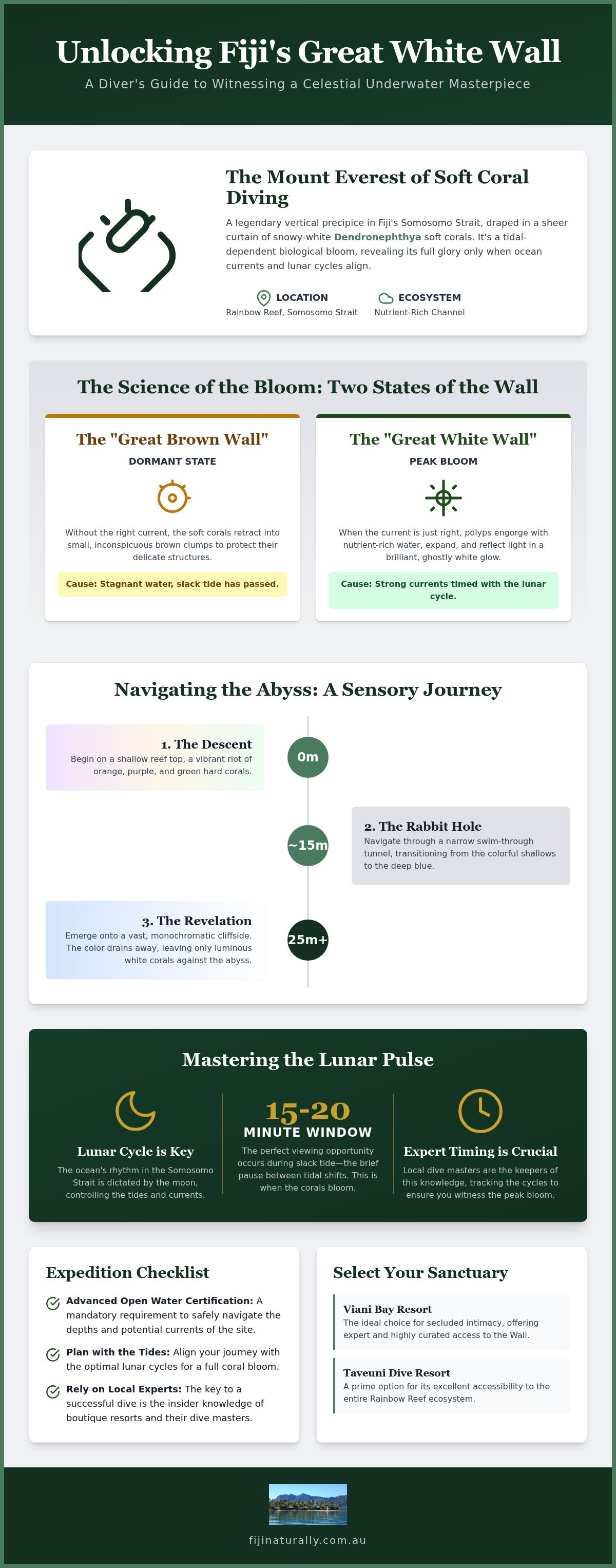
Deep in the heart of the Somosomo Strait, where the currents of the Koro Sea pulse with a rhythmic, heartbeat-like energy, lies a geological and biological marvel. This is the Great White Wall. It's a vertical precipice that drops into the indigo depths, draped in a sheer curtain of snowy-white Dendronephthya soft corals. For the connoisseur of underwater beauty, great white wall fiji diving represents the absolute pinnacle of the sport. It's often called the 'Mount Everest' of soft coral diving, not for its physical height, but for its breathtaking scale and the purity of its monochromatic palette. At its core, the wall is a tidal-dependent biological bloom unique to Fiji, appearing in its full glory only when the ocean grants permission.
The Science of the Soft Coral Capital
The magic of the Rainbow Reef ecosystem isn't accidental. It's born from the unique funnel shape of the Somosomo Strait, which accelerates nutrient-rich waters directly onto the wall's face. These Dendronephthya corals are filter feeders. They don't rely on sunlight like their hard coral cousins; instead, they depend entirely on the flow of the tide. When the current is just right, the polyps engorge with water. They expand. They bloom. Without this life-giving flow, the corals retract into small, inconspicuous clumps to protect their delicate structures. This is the secret of the "Soft Coral Capital." The white appearance is actually a lack of pigment in the coral's translucent tissues, which, when fully inflated, reflect the minimal light of the deep in a brilliant, ghostly glow.
A Visual Symphony: The White-Out Effect
The descent is a profound study in contrast. You begin on a shallow reef top, a riot of orange, purple, and green. It's vibrant. It's loud. But as you pass through a narrow tunnel and emerge onto the face of the wall at roughly 25 metres, the world changes. The color drains away. You're met with a vast, monochromatic cliffside that seems to stretch into eternity. The depth acts as a natural filter, stripping away reds and yellows, leaving only the stark, luminous white of the corals against the deep blue abyss. It's a sensory shift. The silence is heavy. You'll see thousands of delicate polyps swaying in unison, a silent, rhythmic dance that feels more like a dream than a dive. It's here that great white wall fiji diving truly earns its reputation, offering a purity of experience that stays with you long after you've returned to the surface.
The Lunar Pulse: Mastering the Tides for the Perfect Dive
The ocean has a heartbeat. In the Somosomo Strait, that rhythm is dictated by the moon. To experience the ethereal beauty of great white wall fiji diving, you must surrender to the lunar cycle. The corals aren't permanently white. They're translucent, living organisms that only reveal their snowy glory when they're feeding. This feeding requires a specific flow of nutrient-rich water. If you arrive when the currents are stagnant, you won't see a wall of light. You'll see the "Great Brown Wall," a collection of retracted, dormant polyps waiting for the tide to turn. It's a reminder that nature operates on its own schedule, one that demands patience and precision from those who wish to witness its wonders.
Understanding Tidal Windows
The window of perfection is fleeting. It often lasts just 15 to 20 minutes. This is the moment of slack tide, the brief pause between the ocean’s inhale and exhale. Local dive masters are the true keepers of this knowledge. They read the water. They track the moon. They know that as the tide turns, the currents bring a buffet of plankton that triggers the corals to inflate. Scientific monitoring has shown that the Somosomo Strait possesses a high level of resilience, largely due to these constant, cleansing currents. The moon pulls. The water moves. The corals respond. Without this movement, the polyps stay closed, appearing brown or dull. For the photographer, these few minutes of slack water are critical, providing the stillness needed to capture the wall's luminous, swaying polyps before the current picks up again.
Avoiding the Great Brown Wall
Timing is everything. If you dive on an "off" day, the experience can feel underwhelming. The visibility might drop. The corals look like shriveled grapes. Expert operators in Taveuni are protective of this site. They often refuse to take divers down if the conditions aren't right. They want you to see the masterpiece, not a muted version of it. Planning a trip for great white wall fiji diving requires more than just a plane ticket; it requires a deep understanding of the lunar calendar. This is where the guidance of a luxury travel specialist becomes invaluable. We don't just book a room; we align your entire itinerary with the pulse of the strait. We ensure you're in the water exactly when the moon dictates that the wall will bloom, transforming a simple dive into a soul-stirring encounter with the divine.
Navigating the Abyss: The Dive Experience and Site Layout
Sunlight filters through the surface. It dances across a garden of hard corals at just 8 to 10 metres. This is the prologue. It's a serene, shallow introduction that belies the drama hidden just beyond the reef's edge. Here, the water is warm and the colors are familiar. But the true allure of great white wall fiji diving lies in the transition from this sun-drenched plateau into the volcanic heart of the reef. You follow your guide toward a dark opening in the reef floor. This is the 'Rabbit Hole'. It's one of several lava tubes that pierce the limestone structure, offering a narrow, vertical passage into the unknown. Navigating these swim-throughs requires a calm mind and precise buoyancy. It's an intimate, slightly claustrophobic journey that heightens the anticipation for what waits on the other side.
The Tunnel Descent
Inside the tunnel, the world narrows. You move through volcanic shadows, guided by the dim light at the end of the passage. It's a moment of quiet reflection. As you emerge at approximately 25 metres, the darkness vanishes. You aren't just exiting a cave; you're stepping onto a vertical stage. The 'big reveal' is instantaneous. The wall stretches away into the blue, shimmering with its famous white mantle. Because the most striking features sit between 25 and 30 metres, this site is strictly for those with an Advanced Open Water certification. You'll need to manage your air and depth carefully as you hover against the snowy face of the abyss. It's a study in architecture. A test of breath. A gateway to the divine.
Beyond the White: Resident Marine Life
While the soft corals are the protagonists, the supporting cast is equally captivating. Vibrant gorgonian fans cling to the tunnel exits, their intricate skeletons providing a stark contrast to the soft polyps nearby. Look closely among the branches. You might find a longnose hawkfish perfectly camouflaged. If you can pull your eyes away from the wall, look out into the deep blue. The currents that feed the wall also attract the giants. Reef sharks patrol the perimeter. Manta rays occasionally glide past like silent, dark shadows. It's a complete ecosystem. A thriving community. A masterpiece of biodiversity. Finding these tiny residents among the swaying white polyps adds a layer of discovery to every great white wall fiji diving expedition. Each dive offers something new, ensuring that no two visits to this underwater cathedral are ever the same.
Planning Your 2026 Expedition: Seasons and Logistics
A journey to the edge of the abyss is a pilgrimage that begins long before you touch the water. It requires a meticulous alignment of time and place. For those eyeing a 2026 expedition, the process is one of deep curation. You aren't just booking a holiday; you're securing a front-row seat to a celestial event. Because the site is so dependent on the moon, your first step is to consult the lunar calendar. Local experts have already identified key windows, such as the 11th, 12th, 25th, and 26th of April 2026, where the tides are expected to be optimal. These dates represent the heartbeat of the reef. Missing them by even a day can change the entire nature of your great white wall fiji diving experience.
- Consult the 2026 lunar calendar for specific "white-out" windows.
- Choose between the convenience of Taveuni Island or the secluded intimacy of Viani Bay.
- Ensure your Advanced Open Water certification and dive insurance are current.
- Book at least 6 to 9 months ahead to secure space at boutique resorts.
Best Time to Dive Fiji: Seasonal Nuances
The seasons in the Somosomo Strait offer a delicate trade-off between clarity and comfort. From May to October, the Fijian winter brings exceptional visibility, often reaching up to 40 metres. The water is crisp, typically hovering around 22°C to 24°C. It's refreshing. It's clear. It's perfect for wide-angle photography. Conversely, the summer months from November to April offer warmer waters of 26°C to 28°C. While comfortable, this warmth can trigger plankton blooms. These blooms are essential for the health of the corals but can slightly soften the crystalline visibility of the winter months. The shoulder seasons in April and November often provide a harmonious balance of calm seas and clear skies.
Reaching the Rainbow Reef
Accessing this remote corner of the world is part of the adventure. Most travelers fly from Nadi to Taveuni or Savusavu on domestic carriers. From the airport, a boat transit will take you to your chosen sanctuary. Staying at remote Fiji island resorts like Viani Bay Resort or Taveuni Dive Resort provides a distinct advantage. You're closer to the action. You're often the first boat on the water. This proximity is vital when you're chasing a 20-minute tidal window. To ensure your 2026 expedition is perfectly timed and effortlessly executed, contact our specialists to begin your bespoke dive planning. We understand the nuances of the strait and can bridge the gap between world-class diving and soulful luxury.
Curating the Experience: Luxury Resorts and Expert Planning
The great white wall fiji diving experience is more than a simple line in a logbook. It is a sensory journey that deserves a thoughtful, elegant frame. A bucket-list site of this magnitude requires a curated approach that transcends standard, mass-market dive packages. We believe in the "soft adventure" model. This is the art of balancing the raw, exhilarating energy of the Somosomo Strait with the refined tranquility of a high-end retreat. By integrating your expedition into a broader luxury Fiji dive resort itinerary, we ensure that every moment out of the water is as soul-stirring as the time spent beneath the surface.
As a Virtuoso-affiliated agency, we offer more than just bookings. We provide an insider’s perspective. This translates to elite benefits such as room upgrades, daily breakfast, and resort credits at our hand-picked boutique selections. We bridge the gap between world-class technical diving and the understated elegance of a private island escape. It is a soulful, connection-based approach to travel that values depth over surface-level luxury.
Boutique Bases for the Rainbow Reef
Choosing your sanctuary is the most critical decision after the timing itself. Taveuni Dive Resort stands as the specialist’s choice. It is defined by technical precision. Expert local knowledge. Seamless boat logistics. For those who crave a more intimate, off-the-grid luxury, Viani Bay Resort offers direct access to the reef from a secluded mainland cove. It feels hidden. Untouched. Personal. If you prefer to pair your underwater exploration with unique architecture, Matangi Private Island offers treehouse luxury nestled within a private horseshoe bay. It is the pinnacle of seclusion. Each of these locations has been selected for its commitment to environmental harmony and its proximity to the wall.
The Fiji Naturally Advantage
Our vetting process is personal and exhaustive. We have visited over 100 resorts across the islands to ensure they meet our standards for authenticity and intimacy. This isn't corporate travel; it's a shared passion. We work directly with local operators to verify the 2026 lunar cycles, ensuring your stay aligns perfectly with the great white wall fiji diving bloom. Our full-service support covers every detail. We manage your airline tickets. We arrange comprehensive Fiji travel insurance. We handle the complexities so you can focus on the wonder. It is a methodical, intentional way to travel, allowing you to slow down and linger on the beauty of the islands.
Stepping Into the Luminous Abyss
The Great White Wall is more than a destination. It's a fleeting masterpiece. A celestial alignment. A quiet, snowy miracle. To witness it in its prime, you must look beyond the standard itinerary and embrace the rhythm of the tides. You've discovered how the moon dictates the bloom and why the right boutique base makes all the difference. Now, it's time to turn that knowledge into a reality. great white wall fiji diving is a rare privilege, one that requires the steady hand of a specialist to navigate the complexities of the Somosomo Strait.
As a Virtuoso-affiliated agency, we bring a level of care that goes deeper than a simple booking. We've personally vetted every resort we recommend. We understand the heartbeat of the reef. We know the people who call this water home. Let us curate a journey that balances the thrill of the abyss with the tranquility of a world-class retreat. Plan your bespoke 2026 Great White Wall expedition with our experts and secure your place in Fiji's most legendary underwater cathedral. The ocean is waiting. Let's ensure you're there for the reveal.
Frequently Asked Questions
Is the Great White Wall dive suitable for beginners?
No, this site isn't suitable for beginners. Because of the significant depth and the strong currents within the Somosomo Strait, most operators require a minimum of an Advanced Open Water certification. Beginners can certainly enjoy the shallower hard coral gardens nearby, but the actual wall experience requires the buoyancy skills and depth awareness that only come with advanced training and experience.
When is the best time of year to dive the Great White Wall in 2026?
The best time for great white wall fiji diving in 2026 depends entirely on the lunar cycle. While the main season runs from April to October, you must align your visit with specific tidal windows. Key dates include the 11th and 25th of April. Choosing the winter months of July to September offers the clearest visibility, often reaching up to 40 metres.
Do I need a special certification to dive the Great White Wall?
Yes, an Advanced Open Water (AOW) certification is the industry standard for this site. The most iconic part of the dive involves swimming through volcanic tunnels and emerging onto a vertical face at 25 metres. Since you'll spend significant time at depths between 25 and 30 metres, the knowledge of air consumption and nitrogen management taught in advanced courses is essential for your safety.
How deep is the Great White Wall in Fiji?
The Great White Wall reveals its snowy face at approximately 25 metres. While the reef top sits at a shallow 8 to 10 metres, you must descend through lava tubes to reach the vertical drop-off. Most divers explore the wall between 25 and 30 metres to stay within recreational limits. The wall itself continues much deeper into the indigo abyss, far beyond the reach of traditional scuba equipment.
Can I see the Great White Wall on a day trip from Nadi?
No, it's impossible to visit the site on a day trip from Nadi. The Rainbow Reef is located off the coast of Taveuni Island, which requires a domestic flight from Nadi or Savusavu. To truly experience the wall, you should stay at a boutique resort in the North, such as Viani Bay Resort. This ensures you're close enough to hit those narrow 20-minute tidal windows.
What makes the Great White Wall white?
The white color comes from millions of Dendronephthya soft corals. These organisms are translucent. They lack the dark pigments found in many other coral species. When the tidal currents are strong, these polyps engorge with water to feed on plankton. They expand. They bloom. Against the deep blue of the ocean, this massive expansion of pale tissue creates the striking, snowy white-out effect.
What happens if the tides are not right for the dive?
If you dive when the tides aren't right, you'll likely encounter the "Great Brown Wall." Without the nutrient-rich current to trigger feeding, the soft corals retract into small, leathery clumps. The vibrant white disappears. It’s why expert planning is so critical. A miscalculation of even 30 minutes can transform a world-class spectacle into a muted, dormant reef. We verify all 2026 tidal windows with local operators.
Are there sharks at the Great White Wall dive site?
Yes, you'll frequently encounter resident reef sharks patrolling the perimeter of the wall. White-tip and black-tip reef sharks are common sights in the Somosomo Strait. Because the currents bring so much life to the area, you might also spot larger pelagics out in the blue. Keep an eye out for manta rays or even the occasional hammerhead. The wall is a thriving, diverse ecosystem.


