

For Fiji travel for people with mobility issues, share your mobility device’s folded and unfolded dimensions, total weight, battery type and handling instructions before booking transfers. Island journeys may combine road travel with a boat, and boarding can involve docks, steps or uneven surfaces. Transfer details matter as much as the resort itself.
It’s understandable to want more than a room described as accessible. The route from arrival to your room, restaurant, pool and preferred outdoor spaces all affects how comfortably you can settle in.
This guide covers what to tell transfer providers about your equipment, how to assess rooms, bathrooms, pathways and beach access, and which tour details to clarify. You’ll also find a practical pre-departure checklist covering airport assistance, powered-device requirements and weather-related changes.
With careful planning, you can focus on Fiji’s pleasures: warm island air, vivid water and time to unwind, with a clearer picture of what each part of the journey involves.
Key Takeaways
- Assess access across the whole resort journey, from your room and bathroom to dining areas, the pool, beach and pickup point.
- Choose accommodation by matching its layout and surroundings to your specific mobility needs, not by relying on a general accessibility label.
- Look beyond the destination when considering tours: terrain, seating, boarding and rest facilities all shape how manageable an outing may be.
- Before departure, bring together your transport, accommodation, tour and change-of-plan arrangements so the practical details are clear.
1. Sharing mobility-device and transfer requirements
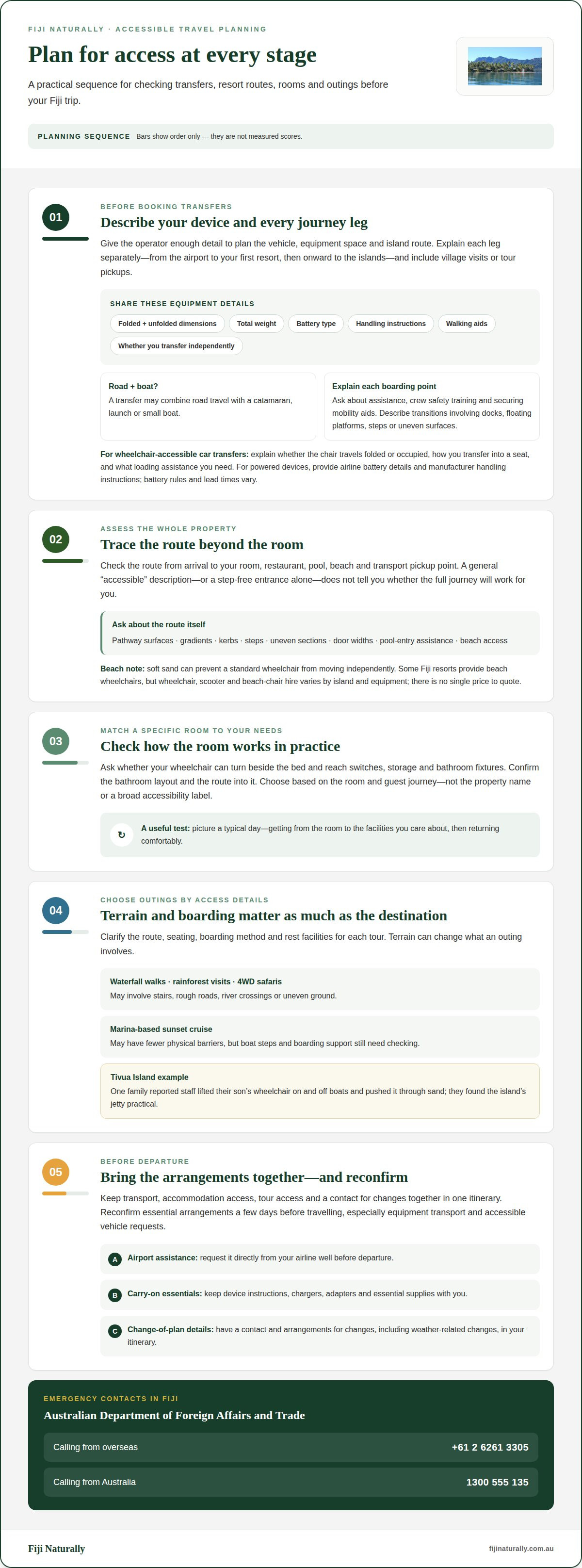
Before booking Fiji transfers, send the operator your mobility device’s folded and unfolded dimensions, total weight, battery type and handling instructions. Include walking aids, such as a folding frame or cane, and explain whether you can transfer independently. These details help plan the vehicle, equipment space and island route.
Describe each journey leg separately, from the airport to your first resort and onward to the islands. A resort transfer may combine a road journey with a catamaran, launch or small boat. Include any village visit or tour pickup in your itinerary so the transport plan accounts for each vehicle change and boarding point.
Discuss boat access separately. Ask how boarding assistance works, whether crew have safety training, and how staff can secure mobility aids on board. The route may include a dock, floating platform, steps or uneven surfaces. Explain the assistance you need at each transition, including moving between a vehicle, jetty and boat.
For a wheelchair-accessible car transfer, describe your chair and how you transfer into a seat. Explain whether the wheelchair travels folded or occupied, its weight, and any handling needs. Ask what vehicle is planned and how loading assistance will work. For powered devices, give the airline battery details and manufacturer’s handling instructions, as battery rules and airline lead times vary.
Reconfirm essential arrangements a few days before travelling, especially equipment transport and accessible vehicle requests. Keep device instructions, chargers, adapters and essential supplies in your carry-on. For emergencies in Fiji, according to Australian Department of Foreign Affairs and Trade, travellers can call the Consular Emergency Centre on +61 2 6261 3305 from overseas. People in Australia can call the same centre on 1300 555 135, according to Australian Department of Foreign Affairs and Trade.
2. Resort room, bathroom, pathway and beach accessibility
Assess the whole resort route, not just the room description. Ask about pathway surfaces, gradients, kerbs, door widths and bathroom layout. In the room, consider whether your wheelchair can turn beside the bed and reach switches, storage and bathroom fixtures. A step-free entrance alone doesn’t show whether the room will meet your needs.
Trace the route to the restaurant, pool, beach and transport pickup point. Ask whether paths have steps or uneven sections, and what assistance is available for pool entry. Soft sand can prevent a standard wheelchair from moving independently. Some Fiji resorts provide beach wheelchairs, but wheelchair, scooter and beach-chair hire varies by island and equipment, so there is no single price to quote.
Access in Fiji can be challenging, though local people may offer practical assistance. Agree on the help you want before anyone moves your wheelchair or assists with a transfer. For a pool visit, discuss the path to the water, entry method and available assistance. Then decide whether the arrangements let you enter and exit safely.
Choose tours by terrain and boarding method. Waterfall walks, rainforest visits and 4WD safaris can involve stairs, rough roads, river crossings or uneven ground. A marina-based sunset cruise may have fewer physical barriers, but boat steps and boarding support still matter. On a Tivua Island day trip, one family reported staff lifted their son’s wheelchair on and off boats and pushed it through sand; they found the island’s jetty practical.
At Nadi International Airport, request assistance directly from your airline well before departure. For a closer look at a Fiji destination, include the full route from arrival to resort facilities in your resort access planning.
3. Accommodation selection
For Australians planning Fiji travel for people with mobility issues, choose accommodation based on the access features that matter most. A resort name alone doesn’t establish wheelchair access throughout its rooms and facilities. Match a specific room and guest journey to your needs rather than relying on a general accessibility label. A property may suit one traveller but not another.
Start by choosing the kind of stay that supports your priorities. If easier road-based transfers matter, Nadi and Denarau are generally the easiest areas for sightseeing and resort transfers. Journeys to the Coral Coast and Pacific Harbour take longer, and road conditions can be less predictable in some areas. Consider travel distance alongside resort features and the experiences you want.
Next, define what a workable day looks like. Someone planning Fiji travel for people with mobility issues may prioritise a step-free route to the pool, while another traveller may focus on room access and bathroom layout. These priorities help narrow accommodation choices without assuming every facility matters equally.
For an international holiday, consider how arrival, transfers and resort routines fit together. A remote island stay may offer the seclusion you want, but add boat boarding to the journey. A mainland property can make road-based outings more straightforward. Compare the full itinerary, including how often you expect to change locations, rather than choosing solely for the scenery or resort style.
Before choosing a property, list your essential room features, preferred facilities and planned activities. Assess each possible stay against those needs, including the routes between key places. Fiji’s resorts differ in setting and layout, so a clear priority list makes your choice more purposeful and helps balance access needs with the experiences that matter most.
4. Confirming arrangements before departure
Before finalising your Fiji trip, bring together four areas: transport, accommodation access, tour access and a contact for changes. Keep the details in one itinerary, including who to reach if a vehicle, boat or room arrangement changes. A clear plan helps connect each part of the journey, from the airport to your resort and planned outings.
For flights, request airport assistance directly from your airline well before departure. Airline lead times and battery rules for powered mobility devices vary, so provide battery details and the manufacturer’s handling instructions. Confirm how your equipment will travel and what assistance is arranged at each airport stage. Keep essential device instructions, chargers, adapters and supplies in your carry-on.
For boat transfers to Fiji’s islands, ask how boarding works in the expected tide and weather conditions. Confirm the boarding point, available assistance and how your mobility aid will be handled. Tropical weather can affect sea conditions and outdoor terrain, so keep a contact for updates and ask tour providers how they manage weather-related changes.
Review each planned tour for practical access details: transport, restrooms, walking distances, boarding steps, terrain and seating. A tour involving rough roads or uneven paths, for example, may need different arrangements from a marina departure. Leave room in the itinerary, as heavy rain can affect pathways and changing sea conditions can alter boat boarding.
Before departure, check that your travel insurance covers medical care and evacuation, plus medical support and mobility equipment. Read the limits for equipment value and exclusions for pre-existing conditions. Reconfirm essential transport arrangements a few days before travelling, particularly equipment carriage and accessible vehicle requests. To shape a Fiji resort booking around your access priorities, plan your resort stay.
Fiji Naturally: Remote authentic Fijian resorts
Fiji Naturally can help shape a resort shortlist around your travel style and mobility priorities. If you’re drawn to a remote island, quiet retreat or resort stay, consider the full journey as well as the setting, including transfer type and the facilities you plan to use.
Fiji Naturally offers remote authentic Fijian resorts, Scuba Dive Resorts, Adults Only Resorts and Family Friendly Resorts. Share the practical details that matter to you, such as room layout, bathroom access, pathways and how you’ll reach planned activities. These priorities can guide your accommodation choices without assuming every resort suits every traveller.
If you’d like help planning a Fiji stay around your preferences, contact Fiji Naturally to discuss your trip.
Shape a Fiji stay around what matters to you
The next step is to turn your access priorities into a trip that feels like yours. Thoughtful planning for Fiji travel for people with mobility issues starts with the experiences you most want to savour, then leaves room for them to unfold at a comfortable pace. Perhaps the best measure of a Fiji holiday isn’t how much you fit in, but how well each day reflects what matters to you.
Fiji Naturally offers Scuba Dive Resorts, Adults Only Resorts and Family Friendly Resorts, each a different starting point for shaping your stay. Share the kind of holiday you hope to have, who is travelling with you, and what would make your time away rewarding. From a restorative island escape to shared family experiences, your priorities can guide the choices ahead.
Contact Fiji Naturally about your trip to start shaping a Fiji escape that feels personal, considered and full of possibility.
Frequently Asked Questions
How wheelchair accessible are Fiji airports, transfers and public transport?
Access varies across airports, vehicles and routes, so plan each connection rather than assuming step-free travel throughout. Request airport assistance through your airline and arrange suitable transport between the airport, accommodation and activities. For road journeys, consider how the vehicle accommodates your mobility aid and where you’ll board. Public transport may not fit your access needs or itinerary, particularly when travelling onward to islands.
What accessibility features should travellers confirm when booking Fiji accommodation?
Ask for details about the specific room for your booking, not just the resort’s general facilities. A floor plan or recent room images can help you understand the layout before arrival. Consider how close the room is to dining and the activities you value. Share your preferred daily routine, such as visiting the restaurant independently or returning to your room between outings, to assess whether the setting works for you.
How accessible are Fiji ferries, boats and island transfers for wheelchair users?
Island boat journeys can involve changing conditions, and boarding may differ with the tide or weather. Before choosing a transfer, establish where boarding takes place and how your wheelchair will be handled between shore and vessel. Ask whether your aid can stay close to you during the crossing or needs to be stowed. Keep plans flexible, as weather can affect boating and outdoor access.
What are Fiji’s rules for bringing mobility aids, batteries and medical equipment on flights?
Airline requirements for powered mobility devices vary, including battery rules and notification lead times. Contact your airline early with your device and battery information, and follow its process for recording the equipment on your booking. Keep essential medication, device instructions and supplies accessible during the journey. Don’t assume one airline’s procedures apply to another, especially if your itinerary includes connecting flights or different carriers.
How can travellers arrange accessible tours and transport in Fiji?
Build your itinerary around one or two priority experiences, leaving space to rest between outings. For each tour, consider how you’ll reach the starting point and whether the activity suits your energy and access needs. A marina departure differs from a nature excursion, while rain can change path conditions. Leaving a flexible day in your plans can make changes easier to manage.
What mobility-related risks should travellers consider in Fiji, including uneven paths, steps and medical access?
Uneven paths, steps, soft sand and heavy rain can make movement more difficult, while changing sea conditions may affect boat boarding. Fiji’s medical facilities can lack specialist equipment, and hospitals usually require a payment guarantee, confirmed medical insurance or an upfront deposit before admission. The medical emergency number in Fiji is 911. Consider medical access and insurance before setting out for remote areas.


