
The most breathtaking dive of your life might not be the one you've seen on every postcard. While many travellers arrive in Fiji seeking a single, definitive "best" site, the reality is a nuanced choice between two distinct underwater kingdoms. Deciding between the Rainbow Reef vs Namena Marine Reserve isn't about finding a winner; it's about matching a specific rhythm of the ocean to your own soul. One offers a delicate, swaying tapestry of neon soft corals. The other provides a raw, humbling encounter with the giants of the deep. Pure. Untouched. Absolute.
It's natural to feel a sense of hesitation when organising the logistics of Fiji's more remote northern reaches. You want the world-class visibility, the secret tides, and the sanctuary of a truly refined resort. This guide promises to demystify these legendary waters, moving beyond the brochures to reveal which reef aligns with your personal diving style. We'll explore the sensory contrasts of these ecosystems, from the 1,100 fish species of Namena to the rushing currents of the Great White Wall. We'll also curate a shortlist of elite resorts like Matangi Private Island and Jean-Michel Cousteau, providing the clarity you need to book a journey that matches your experience level perfectly.
Key Takeaways
- Understand the sensory contrast between the neon soft coral gardens of the Somosomo Strait and the biological scale of the Koro Sea.
- Master the flight logistics required to reach Fiji's remote northern reefs in 2026 without compromising on luxury or comfort.
- Compare the Rainbow Reef vs Namena Marine Reserve based on water clarity and current intensity to find the site that best matches your skill level.
- Review our vetted selection of premier resorts, from Matangi Private Island to Jean-Michel Cousteau, for the most direct access to these underwater wonders.
- Learn why timing your visit with the secret tides and community-managed 'tabu' zones is the key to experiencing Fiji's most pristine environments.
Fiji’s Underwater Titans: The Rainbow Reef and Namena Marine Reserve
Fiji holds a whispered reverence among the global diving community. It's often called the Soft Coral Capital of the World, a title earned through the vibrant, pulsing Dendronephthya corals that thrive in its nutrient-rich currents. As we move through 2026, these ecosystems are entering a period of remarkable health. With the nation's commitment to the Melanesian Ocean Corridor of Reserves and expanded community 'tabu' zones, sites like the Rainbow Reef and Namena have never looked more vibrant. Deciding between the Rainbow Reef vs Namena Marine Reserve is a delightful dilemma for the luxury traveller. One is a kinetic garden; the other is a deep-sea cathedral.
The Aesthetic vs. The Adventure
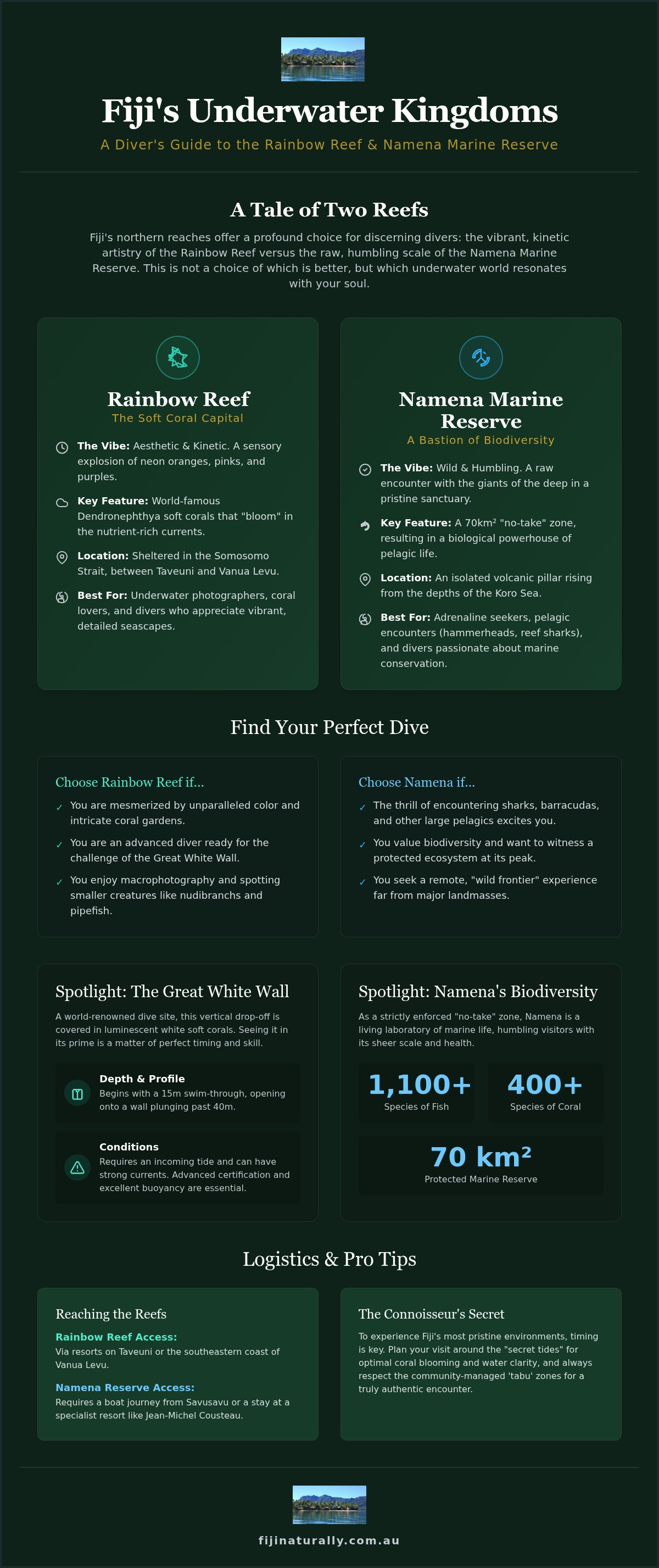
The Rainbow Reef is a masterpiece of colour. Tucked within the Somosomo Strait, it offers a sensory explosion where every square inch of limestone is smothered in neon hues of orange, pink, and purple. It's an aesthetic journey, best experienced when the currents are running just right to "bloom" the corals into full, fluffy displays. In contrast, the Namena Marine Reserve feels like a wild frontier. This 70-square-kilometre sanctuary in the Koro Sea is a strictly enforced "no-take" zone. It's a biological powerhouse where over 1,100 species of fish and 400 species of coral coexist in a balance that feels prehistoric. While the Rainbow Reef dazzles with its intricate gardens, Namena humbles with its sheer scale. Your preference depends on whether you seek the delicate beauty of a coral wall or the adrenaline of a deep-blue pelagic encounter with hammerheads and grey reef sharks.
Geographic Context: Somosomo vs. Savusavu
Accessing these titans requires a journey to Fiji's "North," a region far removed from the busier tourist hubs. The Rainbow Reef sits between the garden island of Taveuni and the south-eastern coast of Vanua Levu. Its tides are rhythmic, driven by the funnel effect of the strait. Namena, however, rises from the depths of the Koro Sea as an isolated volcanic pillar, far from any major landmass. Reaching it typically involves a boat journey from the boutique enclave of Savusavu or a stay at a specialist resort like Jean-Michel Cousteau. This seclusion is precisely why the North remains the connoisseur’s choice. It offers a sense of purity and isolation that is increasingly rare. It's quiet. It's authentic. It's untouched.
Rainbow Reef: Diving the Soft Coral Capital and Great White Wall
The Somosomo Strait is a geographical bottleneck. It's a place where the Pacific Ocean is squeezed between Taveuni and Vanua Levu, creating a rush of life-giving water. These currents are the lifeblood of the reef. They bring the essential nutrients required for the soft corals to expand and feed. When the tide turns, the reef "blooms" in a spectacular display of biological engineering. Shriveled stalks transform into vibrant, translucent fans. This is the "electric" feeling of Somosomo; a dive that feels alive, kinetic, and surging with energy. To witness this reef at its peak is to understand why Fiji remains the pinnacle of soft coral diving.
The Great White Wall Phenomenon
The Great White Wall is a vertical drop-off covered in snowy soft corals. To see it in its prime, timing is everything. It requires an incoming tide to ensure the polyps are fully extended and feeding. These Dendronephthya corals are a specific species that appear luminescent white under the glow of a dive torch, creating the illusion of a snow-covered cliffside in the tropics. It's a deep dive. The journey typically begins with a swim-through at 15 metres that opens onto a sheer wall plunging well beyond 40 metres. Because of the depth and the potential for strong currents, it's a site best suited for advanced divers who can manage their buoyancy with grace and precision.
Beyond the Wall: Signature Rainbow Sites
While the wall is the headline act, the surrounding system is equally mesmerising. The Garden of Eden offers a shallow, light-filled experience where massive coral heads are draped in every imaginable hue. Nearby, the Cabbage Patch reveals a vast, undulating field of green foliose corals that looks like an underwater forest. For those who prefer the smaller details, Annie's Bommies and Fish Factory are essential stops. These sites are macrophotography havens. You'll find nudibranchs, pipefish, and juvenile reef inhabitants tucked into every crevice. Comparing the Rainbow Reef vs Namena Marine Reserve highlights the specific aesthetic of the North. While the Namena Marine Reserve is celebrated for its deep-sea biodiversity and pelagic scale, the Rainbow Reef remains the undisputed capital of texture and colour.
Finding the right boat captain is essential for hitting these windows of perfection. Our team can help you plan a bespoke dive itinerary that ensures you arrive at the wall at the exact moment the white corals reach their peak.
Namena Marine Reserve: A Bastion of Biodiversity in the Koro Sea
Namena is a sanctuary born from deep respect. Since 2004, the people of the Kubulau district have maintained this 70-square-kilometre 'tabu' zone, a traditional prohibition on fishing that has allowed the ecosystem to return to a state of prehistoric abundance. It is a biological powerhouse. While the Rainbow Reef dazzles with its kinetic gardens, the Namena Marine Reserve offers a sense of raw, untamed scale. Documented data from the Wildlife Conservation Society confirms this reef is home to over 1,100 species of fish and 400 species of coral. It's a wilderness. It's a legacy. It's a deep-sea cathedral.
Deciding between the Rainbow Reef vs Namena Marine Reserve often hinges on your desire for pelagic encounters. Namena sits as an isolated volcanic pillar in the Koro Sea, drawing life from the surrounding depths. The experience is divided between the dramatic sheer drops of the North Wall and the intricate pinnacles of the South Barrier. Each dive feels like an audience with the ocean's most formidable inhabitants, protected by a community that values ecological integrity over surface-level appeal.
The Pelagic Powerhouse
Grand Central Station is the reserve's most famous stage. Here, the current brings a thrumming energy to the water. You'll find yourself suspended among thousands of schooling barracuda, bigeye trevally, and chevron barracuda. It's the most consistent site in Fiji for shark sightings. Resident grey reef sharks patrol the edges of the drop-offs, while lucky divers may witness scalloped hammerheads rising from the blue. Because Namena sits on a migratory path, the boat journey from Savusavu often includes sightings of spinner dolphins or, during the right season, the haunting song of humpback whales.
Pristine Coral Habitats
The architecture of Namena is as impressive as its inhabitants. The "Chimneys" are two massive coral towers that rise from the seabed, draped in a mix of hard and soft corals that thrive in the exceptional visibility. On a clear day, the sightlines often exceed 30 or 40 metres. This clarity allows for a dual experience; you can scan the blue for giants or tuck into the reef to find microscopic treasures. Expert guides from resorts like Jean-Michel Cousteau or Namale specialise in spotting the reserve's macro wonders.
- Look for the tiny, camouflaged pygmy seahorses clinging to gorgonian fans.
- Discover rare nudibranchs in neon hues hidden in the coral crevices.
- Observe the intricate symbiotic relationships between anemonefish and their hosts.
Head-to-Head Comparison: Logistics, Conditions, and Skill Levels
Choosing between the Rainbow Reef vs Namena Marine Reserve often depends on your tolerance for travel and your appetite for clarity. Namena is an oceanic sentinel. It offers visibility that frequently exceeds 40 metres, a result of its isolated position far from the silt of large river systems. The Rainbow Reef, while still remarkably clear at 20-30 metres, is a more nutrient-dense environment. This organic richness is what fuels the world-famous soft corals, though it slightly softens the crystalline edges of the blue. It is a trade-off between the sharp focus of a deep-sea cathedral and the soft-focus glow of a kinetic garden.
The physical demands of these sites differ significantly. Somosomo currents are predictable, rhythmic, and powerful. They follow the moon. Divers must time their entries to coincide with the tide's turn to see the reef in full bloom. Namena's conditions are more oceanic. While both regions offer sites for intermediate divers, Namena’s deep pinnacles and exposed walls require more disciplined buoyancy control. Access also varies:
- Rainbow Reef: A short, 10-20 minute boat ride from resorts on Taveuni or Viani Bay.
- Namena: A longer, 45-60 minute journey from Savusavu, often weather-dependent.
- Skill Level: Rainbow Reef is accessible to all; Namena rewards the experienced with its deep-water verticality.
When to Visit: The 2026 Seasonal Guide
The golden window for 2026 remains July through September. During these months, the southeast trade winds provide a cooling breeze and the underwater visibility reaches its annual peak. The water temperature dips to a crisp 24-25°C, making a 5mm wetsuit a wise addition to your kit. This period also offers a rare biological overlap. You can experience the peak manta ray season at nearby cleaning stations while listening for the haunting, underwater songs of migrating humpback whales in the Koro Sea. It is a time of profound transition and abundance.
Logistics: Reaching the Remote North
Reaching Fiji's northern dive hubs is an exercise in intentional travel. It involves the 'Island Hopper' experience, utilising small aircraft from Nadi to the airstrips of Taveuni or Savusavu. Luggage management is a specific skill here. While standard domestic tickets often cap checked bags at 15kg, we help our clients navigate these restrictions to ensure specialised dive gear arrives safely. For a deeper look at the accommodation that supports these journeys, explore our Luxury Fiji Dive Resorts guide. Managing these flight patterns requires an insider's touch to ensure your transition from the international terminal to the reef is seamless and stress-free.
The complexity of northern logistics is why many connoisseurs prefer a curated approach. You can contact our specialist team to arrange your 2026 island-hopper flights and resort transfers with absolute precision.
Curating Your Luxury Basecamp: Where to Stay for Reef Access
Your sanctuary on land should mirror the grace of the world beneath the waves. Proximity is the ultimate luxury. It is the difference between a rushed morning and a slow, intentional descent into the blue. When weighing the Rainbow Reef vs Namena Marine Reserve, your choice of island dictates your daily rhythm. While some operators suggest staying anywhere in the North, we know that a 20-minute boat ride offers a vastly different experience than a 60-minute journey across open water. Time is the one thing we can't give you back; we prefer you spend it underwater.
Premier Resorts for the Rainbow Reef
Basing yourself for the Rainbow Reef typically means choosing between the "Garden Island" of Taveuni or the secluded enclave of Viani Bay. Viani Bay Resort offers the most intimate access to the Somosomo Strait. It is a place for those who value privacy and proximity above all else. You are essentially living on the edge of the reef. For a different kind of seclusion, Matangi Private Island Resort provides an iconic experience. It features luxury treehouses and a dedicated dive team that understands the secret windows of the Great White Wall. It's sophisticated. It's authentic. It's expertly run.
Premier Resorts for Namena Marine Reserve
Basing yourself in Savusavu is essential for consistent Namena access. Jean-Michel Cousteau Resort remains the premier choice for the ecologically minded. With an on-site marine biologist and a deep commitment to the reserve's history, the experience here is educational as well as aspirational. Alternatively, Namale Resort provides a sense of dramatic volcanic majesty. Its private cliffside vistas offer a perfect space to decompress after a day with the hammerheads. To understand the deeper cultural connection of these stays, explore our guide on the Authentic Fiji Resort Experience.
For the ultimate 2026 dive holiday, we often curate dual-destination itineraries. This allows you to experience the sensory contrast of the Rainbow Reef vs Namena Marine Reserve in a single, seamless trip. We've personally visited over 100 locations to ensure the dive boats are modern, the gear is pristine, and the dive masters are the best in the Pacific. We don't just book rooms; we curate the entire underwater journey from the moment you land in Nadi. Our team specialises in the logistics of island-hopper flights, ensuring your gear and your spirit arrive together, ready for the first descent.
Your Next Descent into the Crystalline North
The ocean's rhythm is calling. Whether you choose the neon tapestry of the Somosomo Strait or the deep-blue majesty of the Koro Sea, your journey to the North will be transformative. The comparison of the Rainbow Reef vs Namena Marine Reserve reveals two distinct souls of the Pacific. One offers a delicate, sensory bloom of soft corals. The other provides a raw encounter with the giants of the deep. Both are entering a period of unprecedented vitality. It's a rare window of opportunity to witness these rejuvenated ecosystems at their peak.
Finding the perfect balance between these titans requires more than just a map. It requires an insider's touch. With over 20 years of Fijian expertise and a portfolio of personally vetted dive resorts, we ensure your escape is as seamless as a drift dive. Let our Fiji Luxury Travel Specialists plan your bespoke dive itinerary to unlock Virtuoso-exclusive benefits and the most refined underwater experiences in the islands. The water is warm. The visibility is endless. Your sanctuary awaits.
Frequently Asked Questions
Which is better for beginners, Rainbow Reef or Namena?
Both locations offer shallow sites, but the Rainbow Reef is generally more accessible for beginners due to its sheltered Garden of Eden and various shallow bommies. While the Namena Marine Reserve has spectacular shallow pinnacles, its exposed oceanic position can lead to more challenging surface conditions. We recommend starting in the Somosomo Strait where the vibrant soft corals are often visible at shallower depths, providing a gentle introduction to Fiji's underwater magic.
Can I dive the Great White Wall every day?
You cannot dive the Great White Wall every day. This site is strictly governed by the moon and the tides. It requires a specific incoming tide to ensure the soft corals are fully expanded and feeding. Diving it during a slack or outgoing tide results in a grey, dormant wall. Our specialists track these windows precisely to ensure your visit coincides with the spectacular white-out effect that makes this site legendary.
How far is Namena Marine Reserve from Savusavu?
Namena Marine Reserve is approximately 45 to 60 minutes from the Savusavu coast by boat. This journey takes you across the deep waters of the Koro Sea, where you might spot spinner dolphins or migrating whales. Because of the distance, trips are often weather-dependent. Staying at a premier resort like Jean-Michel Cousteau or Namale ensures you have the most comfortable and direct access to this remote volcanic sanctuary.
Is the diving in Fiji better than the Great Barrier Reef?
While the Great Barrier Reef is famous for its scale and hard coral structures, Fiji is the undisputed Soft Coral Capital of the World. The comparison of Rainbow Reef vs Namena Marine Reserve highlights a level of vibrant colour and biological density that is rare in Australian waters. Fiji offers a more intimate and secluded experience, focusing on the kinetic beauty of Dendronephthya corals and the sheer verticality of its deep-sea walls.
What is the best month for diving in Fiji in 2026?
The peak window for 2026 is between July and September. These months offer the most consistent visibility, often exceeding 30 to 40 metres in the Koro Sea. The air is slightly cooler and the southeast trade winds provide a refreshing breeze. While the water temperature drops to around 24 or 25 degrees Celsius, the clarity and the arrival of migrating humpback whales make this the connoisseur’s preferred time to visit.
Do I need a liveaboard to see Namena Marine Reserve?
You don't need a liveaboard to experience the Namena Marine Reserve. While liveaboards do frequent the area, several boutique resorts in Savusavu offer daily excursions to the reserve. Choosing a land-based sanctuary like Jean-Michel Cousteau Resort allows you to balance world-class diving with the relaxation of a luxury retreat. This approach provides a more soulful connection to the land and the local communities who protect these waters.
Are there sharks at the Rainbow Reef?
Yes, you will encounter sharks at the Rainbow Reef, though they are typically smaller reef species. White-tip and black-tip reef sharks are frequent residents among the coral gardens. If you are seeking a higher concentration of larger pelagics, the Rainbow Reef vs Namena Marine Reserve comparison tilts toward Namena. The reserve is a bastion for grey reef sharks and schooling hammerheads, offering a more raw and humbling encounter with the ocean's apex predators.
What gear should I bring for a luxury Fiji dive holiday?
We recommend bringing your own mask, snorkel, and dive computer for a perfect fit and familiarity. While our vetted luxury resorts provide high-end rental equipment, a personal 3mm or 5mm wetsuit is ideal for the cooler, clearer waters of the peak season. Don't forget a reef-safe sunscreen and a high-quality underwater camera. The colours in the Somosomo Strait are so vivid that you'll want to capture every shimmering detail of the soft coral gardens.


