
Most divers believe the Great White Wall is a permanent fixture of the Somosomo Strait, but it's actually a fleeting biological performance that only opens its doors a few times a month. You've likely heard the whispers of a vertical drop covered in snow-white dendronephthya corals; a sight so rare it defines most bucket lists. Yet, the anxiety of arriving only to find the wall dormant and grey is a common fear for those planning their great white wall fiji diving adventure.
We understand that timing is everything. This guide ensures you never miss the bloom by detailing the exact lunar cycles and tidal requirements needed for the soft corals to expand in their full, ethereal glory. We'll explore the intricate topography of the 32km Rainbow Reef, provide the confirmed 2026 dive dates, and curate a luxury itinerary that balances high-adrenaline drift diving with the tranquility of Fiji's most exclusive boutique retreats. From the secret lava tube entrance at 12 meters to the logistics of a seamless island transfer, your journey into the soft coral capital starts here.
Key Takeaways
- Understand the unique funnel effect of the Somosomo Strait and why these soft corals rely on specific water pressure to reveal their snowy brilliance.
- Secure the perfect window for great white wall fiji diving by aligning your 2026 itinerary with the precise new and full moon phases.
- Prepare for the technical descent through a hidden 15-meter tubular swim-through, transitioning from vibrant reef tops to the legendary vertical drop.
- Explore curated luxury at boutique resorts like Viani Bay or Matangi Private Island, where world-class diving meets soulful, secluded island retreats.
- Learn why a specialist's eye is essential for navigating local tide tables to ensure you witness the reef in its full, expanded glory.
The Legend of the Great White Wall: Why It’s the Holy Grail of Fiji Diving
To descend upon the Great White Wall is to witness one of nature's most exclusive performances. A vertical precipice. A sheer drop. A frozen waterfall of life. This legendary site is a vertical drop-off that plunges into the deep indigo of the Somosomo Strait, the narrow channel separating Taveuni and Vanua Levu. While many sites claim beauty, few command the reverence this wall does. Jacques Cousteau famously dubbed Fiji the "Soft Coral Capital of the World," and this specific site is the undisputed crown jewel of that title. It's a place where the ocean floor simply disappears, replaced by a staggering, icy-white expanse of Dendronephthya corals that stretch as far as your torchlight can reach.
This isn't a view you can simply book and expect to see. The wall is temperamental. It only "blooms" when the lunar cycle and tidal currents align with surgical precision. Without this synergy, the masterpiece remains hidden from view. For those seeking the ultimate great white wall fiji diving experience, understanding this rhythm is the difference between witnessing a legendary wonder and seeing a silent, dormant cliff.
The Rainbow Reef Connection
The wall belongs to the legendary Rainbow Reef, a 32km stretch of kaleidoscopic marine life that serves as the lifeblood of the region. This massive reef system acts as a biological filter, capturing nutrient-rich waters that funnel through the strait. Over 230 species of hard and soft corals thrive here, creating a dense tapestry of biodiversity. Before you even reach the drop-off, the reef crest teems with life. Anthias dart through staghorn corals. Anemones sway in the current. It's a sensory overload of color that serves as a vibrant, chaotic prelude to the serene, monochrome majesty of the wall itself.
What Makes the 'White' Wall White?
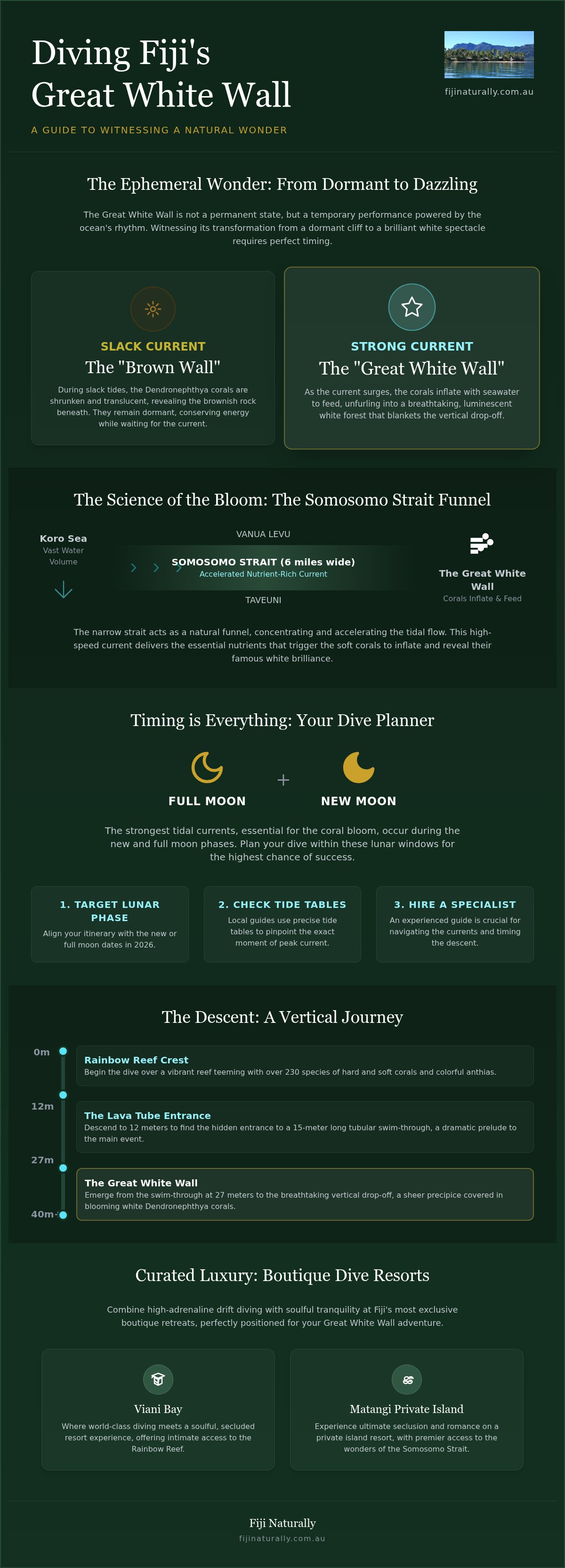
The term "white" is actually a description of the coral's active state rather than its permanent pigment. When the currents are slack, these soft corals are translucent and shrunken, revealing the brownish hue of the rock beneath. Divers who arrive at the wrong time often describe it as the "Great Brown Wall," a disappointing sight for such a long journey. However, when the tide turns, the transformation is breathtaking. The expansion is triggered by the surge of nutrient-dense currents that force the polyps to inflate with seawater, transforming the reef from a muted tan to a brilliant, luminescent white. It's a living, breathing architecture of snow and ice beneath the tropical waves. Achieving this view requires the expertise of a guide who understands the exact moment the water pressure hits the necessary threshold for the great white wall fiji diving bloom.
The Science of the 'White': Understanding Tides, Currents, and Coral Blooms
The magic of the wall isn't magic at all; it's physics. The Somosomo Strait acts as a natural bottleneck, a narrow passage where the ocean's energy is concentrated. It's only 6 miles wide. As the tide shifts, massive volumes of water from the Koro Sea are forced through this gap, creating a powerful "funnel effect." This acceleration is the lifeblood of the reef. It brings a constant, high-speed delivery of nutrients to the organisms anchored below, creating the high-octane environment required for great white wall fiji diving to reach its peak.
Unlike the hard corals found on the reef's crest, soft corals lack a rigid calcium carbonate skeleton. They are essentially hydrostatically supported. To stand upright against the rushing current, they must pump themselves full of seawater. When the current is slack, they appear shrunken and dull. But as the water speed picks up, they inflate, unfurling their polyps in a desperate, beautiful feeding frenzy. This expansion is a physical necessity; without the pressure of the current, the wall literally loses its structure.
Dendronephthya: The Architect of the Wall
The star of the show is the Dendronephthya coral. These colonies are distinct. Cauliflower-like. Translucent. Pure. Because they lack symbiotic algae, known as zooxanthellae, they don't rely on sunlight for energy. This allows them to thrive in the deeper, darker reaches of the wall where other corals would starve. They are obligate filter feeders, meaning they are entirely dependent on the plankton carried by the current. Their survival is a dance with the tide. They wait in a dormant state until the water brings their next meal, at which point they bloom into the snowy white forest that divers travel across the globe to see.
The 'Good Water' of the Somosomo Strait
In the local language, 'Somosomo' translates to 'good water' or 'rich water.' It's an apt description. The strait benefits from a massive upwelling of nutrient-dense water from the deep Fiji Basin. This cold, rich water rises to the surface as it hits the reef, providing a buffet for the entire ecosystem. This constant infusion of nutrients is why the corals here are so much more vibrant and dense than in other parts of the Pacific. It's a pristine, high-flow environment that requires precise planning to visit. Because the exact window for great white wall fiji diving is dictated by the lunar cycle, speaking with a specialist who understands the 2026 tide tables is the only way to ensure you don't arrive to find the wall in its dormant state.
Navigating the Somosomo Strait: The Best Times to Dive in 2026
Scheduling a successful great white wall fiji diving trip is less about luck and more about celestial mechanics. It's a calculated encounter. You don't simply show up and hope for the best; you wait for the cosmos to align. To witness the wall in its full, snowy glory, your arrival must be timed with the new or full moon phases of 2026. These periods create the necessary current flow to nourish the soft corals, but the dive itself occurs during the brief "slack tide." This is the window when the current pauses, allowing for safe entry and the crystalline visibility required to see the wall's true scale.
To ensure your journey is seamless, we recommend a methodical approach to planning:
- Align with the moon: Your travel window must center on the three days surrounding a new or full moon. For example, April 2026 offers prime dates on the 10th, 11th, 24th, and 25th.
- Verify with a specialist: Consult a Fiji luxury travel specialist to cross-reference these dates with local naval charts. Micro-currents in the strait can vary from generic regional tide tables.
- Commit to a 7-night stay: Tropical weather is unpredictable. A week-long itinerary provides a buffer for wind or swell, ensuring you don't miss your tidal window.
- Prioritize boat speed: Choose a resort with a fast, dedicated dive vessel. A 10-20 minute transit time is vital for hitting the precise moment of slack water before the current turns.
The 2026 Seasonal Outlook
Visibility in the Somosomo Strait is legendary, often exceeding 30 meters between May and October. This is the dry season, offering the clearest water for photography. However, July and August frequently bring the "Southeasterly Trades." These winds can roughen surface conditions and make the boat ride more adventurous. For the most tranquil experience, aim for the shoulder months of May, June, or September. These periods offer a serene balance of calm seas, clear skies, and the perfect water temperature for long, contemplative dives.
The Lunar Logic: New Moon vs. Full Moon
While both phases trigger the coral bloom, many "Passionate Insiders" prefer the new moon for great white wall fiji diving. The gravitational pull during a new moon creates a specific current intensity that often encourages a more robust feeding response from the Dendronephthya colonies. Reading a local tide chart for the Rainbow Reef is an art; you're looking for the specific transition where the water remains still just long enough for a descent. It's a fleeting moment of stillness in a high-energy channel, a quiet pause that reveals Fiji's most iconic masterpiece.
The Descent: Topography, Depth, and the Dive Experience
The dive begins in the "Cabbage Patch." It's a garden of foliose corals. Vibrant. Shallow. Sunlit. This shallow reef top, sitting at roughly 8 to 10 meters, serves as the staging area for what's to come. You'll check your gauges, find your buoyancy, and follow your guide toward a dark, circular opening in the reef floor. This is the entrance to the legendary lava tube, a natural tunnel that serves as a portal between the colorful shallows and the monochrome majesty of the deep.
Navigating the lava tube requires a slow, intentional pace. You enter at 12 meters, descending through a shadowed corridor where the world narrows to the glow of your torch. You might spot a resident lionfish or a delicate gorgonian fan clinging to the ceiling as you move. Then, the tunnel ends. You emerge at 23 meters, and the scale of the wall hits you. It's an infinite vertical drop. A frozen blizzard. A living architecture. The silence. The scale. The contrast. These elements combine as you hover against a sheer cliff face covered in millions of icy-white soft corals that stretch into the indigo abyss.
Technical Specs: Depths and Durations
While the wall plunges well beyond recreational limits, the most dense concentration of white soft corals is found between 20 and 30 meters. This depth profile means your bottom time is a precious commodity. On a standard air dive, you'll have only a few minutes to soak in the majesty before your computer demands an ascent. We often recommend diving with Nitrox for great white wall fiji diving. By using an enriched air blend, you can safely extend your no-decompression limits, allowing for a longer, more contemplative encounter with the wall. It's the difference between a fleeting glance and a deep, meaningful connection with the reef.
Swim-Throughs and Hidden Life
This vertical landscape isn't just a monochrome backdrop. It's a sanctuary for the rare and the hidden. Within the crevices of the swim-throughs and along the face of the wall, you'll find:
- Gorgonian Fans: Giant, intricate lattices that thrive in the nutrient-rich shadows of the tunnels.
- Anthias Clouds: Thousands of orange and purple fish that greet you in a chaotic, colorful cloud upon your return to the sunlit reef top.
- Blue Water Patrollers: Keep one eye on the open ocean; it's common to see grey reef sharks or even a passing manta ray patrolling the currents off the wall.
Planning this specific profile requires an intimate knowledge of the Somosomo Strait's unique behavior. If you're ready to experience this masterpiece firsthand, contact our specialist team to begin crafting your bespoke dive itinerary.
Curated Luxury: Boutique Dive Resorts for the Ultimate Escape
Selecting the right base for your great white wall fiji diving expedition is an exercise in intentionality. It's about more than just a view. It's about proximity. It's about local wisdom. It's about the rhythm of the strait. Because the window to see the wall in bloom is so narrow, where you choose to rest your head determines how easily you can hit that precise tidal mark. We've personally vetted the following sanctuaries for their commitment to both underwater excellence and soul-stirring hospitality.
- Viani Bay Resort: Intimate. Authentic. Deeply connected. This diver-centric retreat is located directly on the shores of the bay, offering the fastest access to the Rainbow Reef. It's a place for those who prioritize the ocean above all else.
- Matangi Private Island Resort: Seclusion. Romance. Treehouse luxury. For couples seeking a blend of high-adventure diving and private island tranquility, Matangi remains the gold standard. It's a sanctuary of understated elegance.
- Taveuni Dive Resort: Sustainable. Purpose-built. PADI-focused. This resort offers a methodical, professional approach to diving with a team that knows every crevice of the Somosomo Strait.
- Remote Authentic Fijian Resorts: For those seeking total isolation, we recommend secluded villas tucked away on hidden coastlines. These retreats offer private beach dining and a sense of purity that is increasingly rare.
The Specialist's Recommendation
For the true connoisseur, Viani Bay Resort stands out as the definitive insider choice. Its location is its greatest asset. The dive team here doesn't just look at a chart; they feel the water. Their ability to time the Great White Wall perfectly is legendary. When you book your stay through a specialist, you also gain access to Virtuoso-affiliated agency benefits, ensuring your journey is as seamless as it is rewarding. This level of curation ensures that every logistical detail is handled, leaving you free to focus on the descent.
Beyond the Dive: Post-Wall Relaxation
The intensity of a drift dive through the strait requires a graceful transition back to land. We suggest unwinding with a traditional Fijian kava ceremony, a grounding ritual that connects you to the soul of the islands. You might also explore the "Garden Island" of Taveuni, visiting local villages where the pace of life remains beautifully slow. For those days when you choose to stay dry, we've curated a guide to the Authentic Fiji Resort Experience, highlighting the spa treatments and cultural immersions that define high-end island travel. Whether it's a massage overlooking the reef or a walk through a tropical rainforest, the experience continues long after you've surfaced.
Witness the Masterpiece: Your 2026 Descent
The Great White Wall is a fleeting biological miracle. It's a reminder that the ocean's greatest wonders don't wait for us; we must wait for them. By understanding the lunar logic of the Somosomo Strait and selecting a base that prioritizes technical expertise, you've already taken the first step toward a successful great white wall fiji diving expedition. This is an encounter defined by precision. The silence. The scale. The purity. It's a sight that stays with you long after you've returned to the surface.
Planning such a rare experience requires a specialist's touch. Our team has personally vetted over 100 Fiji locations to ensure every detail of your journey meets our standard for understated elegance. From Virtuoso-affiliated benefits to bespoke itineraries crafted for discerning divers, we handle the logistics so you can focus on the moment the wall comes alive. Let our Fiji specialists curate your 2026 Great White Wall expedition and discover the soul of the Rainbow Reef. The white is waiting.
Frequently Asked Questions
Is the Great White Wall dive suitable for beginners?
No, this dive is strictly for experienced divers. The combination of depth, current, and the swim-through at 12 meters requires excellent buoyancy and comfort in moving water. Most local operators require an Advanced Open Water certification and a minimum of 30 logged dives. Beginners are better off exploring the shallower, calmer gardens of the Rainbow Reef before attempting this vertical masterpiece.
Why is the Great White Wall sometimes brown instead of white?
The wall appears brown when the soft corals are retracted. These organisms lack a rigid skeleton and only expand to feed when the current is running at a specific strength. Without the nutrient-rich flow of the Somosomo Strait, the polyps shrink, revealing the muted reef rock underneath. This is why great white wall fiji diving must be timed perfectly with the local tide tables to witness the snowy bloom.
What is the best month to dive the Great White Wall in 2026?
May to October is the dry season, offering the most consistent visibility which often exceeds 30 meters. While July and August are clear, they can be windy due to the southeasterly trade winds. For the most tranquil experience, we recommend May, June, or September. These shoulder months offer a serene balance of calm surface conditions and the clear, nutrient-dense water required for the corals to expand.
Do I need a special certification like Advanced Open Water?
Yes, you'll need an Advanced Open Water certification or equivalent. Because the dive profile involves a descent through a tunnel ending at 25 meters, it exceeds the depth limits of a standard Open Water diver. Most boutique resorts also suggest having a good grasp of drift diving techniques. If you're looking to gain these skills, many of our vetted resorts offer specialized "Learn to Dive" packages.
How deep is the Great White Wall in Fiji?
The Great White Wall begins at a depth of 20 meters and plunges vertically into the deep. Divers typically enter through a lava tube at 12 meters, descending internally before emerging onto the sheer face at 25 meters. While the wall continues much deeper, the most vibrant and dense colonies of white Dendronephthya corals are found in the 20 to 30 meter range, where the current is strongest.
Can I see the Great White Wall on a day trip from Nadi?
No, a day trip from Nadi is not feasible. The Great White Wall is located in the remote North, requiring a domestic flight to Taveuni or Savusavu. To truly experience the magic of the Rainbow Reef, you should plan for a minimum stay of seven nights at a boutique resort. This allows enough time to align your dives with the specific tidal windows and lunar cycles required for the wall to bloom.
What should I bring for a Fiji dive holiday?
You should bring your dive computer, a 3mm wetsuit for comfort, and reef-safe sunscreen to protect the delicate ecosystem. It's also vital to carry your certification card and proof of dive insurance. While our partner resorts offer high-quality rental equipment, bringing your own mask and fins ensures a more intimate and comfortable fit during the high-energy drift dives found in the Somosomo Strait.
Are there sharks at the Great White Wall?
Yes, sightings of reef sharks are very common at this site. Grey reef sharks and white-tip sharks frequently patrol the blue water just off the vertical drop, drawn by the same nutrient-rich currents that feed the soft corals. Because the wall borders the deep Fiji Basin, you might even spot larger pelagics like manta rays or eagle rays passing through the strait during your safety stop.


